Renova Hospitals Logo
Home Blogs ACL Tear: Surgery vs Physiotherapy -- How to Choose
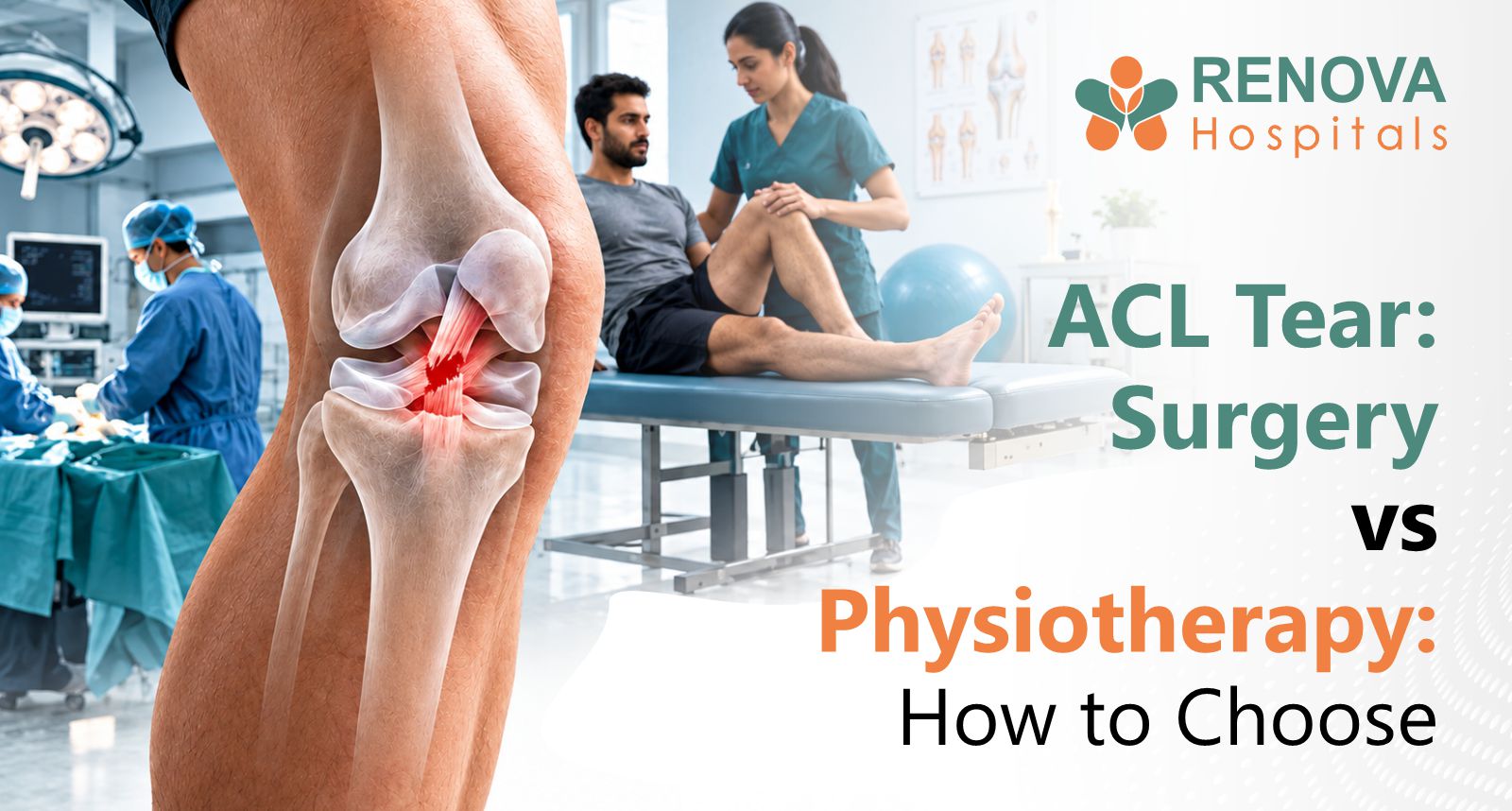
ACL reconstruction vs physiotherapy for anterior cruciate ligament injuries

By Dr. Udaya Bhaskar

November 18, 2026

ACL Tear: Surgery vs Physiotherapy -- How to Choose

Key Takeaways


  • ACL tears range from partial (Grade I-II) to complete (Grade III); the treatment pathway differs significantly between grades.
  • Partial tears and low-demand patients can often be managed with structured physiotherapy alone.
  • Complete tears in active individuals, those with instability despite physio, or patients with associated meniscal injuries generally require arthroscopic ACL reconstruction.
  • Hamstring tendon autograft is the most commonly used graft in India, offering reliable outcomes with low donor-site morbidity.
  • Return to pivoting sport typically takes 9-12 months; premature return increases rerupture risk.
  • ACL prevention programmes (FIFA 11+) reduce injury rates by 30-50% in team sport athletes.
  • Renova Institute of Orthopaedics and Robotic Surgery (RIOR), Renova NIGL Hospital, Hyderabad, offers arthroscopic ACL and multiligamentous knee reconstruction under Dr. Udaya Bhaskar.

What Is the ACL and Why Does It Matter?


The anterior cruciate ligament (ACL) is one of the four main ligaments stabilising the knee joint. It runs diagonally across the middle of the knee from the femur (thigh bone) to the tibia (shin bone), controlling forward movement of the tibia and rotational stability of the knee. Without an intact ACL, the knee can feel unstable - particularly during cutting, pivoting, jumping, or deceleration movements.

ACL tears are graded on a scale of I to III: a Grade I sprain involves microscopic tears with intact ligament continuity; a Grade II (partial tear) involves significant structural damage but some continuity remains; a Grade III (complete tear) represents full disruption of the ligament. The clinical management depends heavily on which grade is present.

How Does an ACL Tear Happen?


The ACL is most commonly injured during non-contact mechanisms -- the player changes direction, decelerates suddenly, or lands awkwardly from a jump. A distinctive "pop" is often felt at the moment of injury, followed almost immediately by swelling and an inability to bear full weight.

Common scenarios include:

  • Sudden deceleration while running (football, cricket outfielder sprints).
  • Pivoting with the foot planted (kabaddi, basketball, badminton).
  • Landing from a jump with the knee in a valgus (knock-knee) position.
  • Direct contact (less common): Tackle or collision driving the knee inwards.

Women athletes sustain ACL injuries at a higher rate than men, owing to differences in hip anatomy, muscle activation patterns, quadriceps dominance, and hormonal factors affecting ligament laxity.

Symptoms of an ACL Tear


  • A loud "pop" heard or felt at the moment of injury.
  • Immediate severe pain and inability to continue activity.
  • Rapid knee swelling (haemarthrosis) within the first few hours due to bleeding within the joint.
  • A feeling that the knee "gave way" at the time of injury and may continue to do so.
  • Loss of full range of motion.
  • Tenderness along the joint line, particularly if a meniscal tear has occurred simultaneously.

Approximately 50% of ACL tears are accompanied by other injuries: medial collateral ligament (MCL) damage, meniscal tears (the "unhappy triad"), and, in some cases, bone bruising visible on MRI.

How Is an ACL Tear Diagnosed?


Physical Examination Tests

An experienced orthopaedic surgeon can often diagnose an ACL tear clinically:

  • Lachman test: The most sensitive clinical test. The examiner stabilises the femur and draws the tibia forward; increased anterior translation with a "soft" end-feel indicates ACL rupture.
  • Anterior drawer test: Similar but performed with the knee at 90 degrees.
  • Pivot shift test: Assesses rotational instability. A positive pivot shift is highly specific for ACL rupture and correlates with functional instability.

Imaging

  • X-ray: Excludes bony fractures. A small avulsion fracture from the tibial attachment (Segond fracture) is pathognomonic of ACL injury on X-ray.
  • MRI of the knee: The definitive imaging investigation. It confirms the diagnosis, grades the tear, identifies associated meniscal and cartilage injuries, and guides surgical planning. MRI accuracy for ACL tear exceeds 90%.

ACL Tear Treatment: Surgery vs Physiotherapy -- How to Choose


This is the most commonly asked question when a patient presents with an ACL tear, and the honest answer is: there is no universal right answer. The decision requires an individualised discussion with your orthopaedic surgeon considering several factors.

When Is Physiotherapy (Non-Surgical) Treatment Appropriate for ACL Tear?

Not every ACL tear requires surgery. Evidence supports non-operative treatment in specific circumstances:

  • Grade I and some Grade II (partial) ACL tears where significant ligamentous continuity is preserved.
  • Low-demand patients: Older, non-athletic individuals who do not participate in pivoting or cutting sports and are not troubled by instability in daily life.
  • Isolated ACL injury without associated meniscal tear or multi-ligament damage.
  • Skeletally immature children where growth plates are still open (surgical techniques vary; physeal-sparing approaches are used when surgery is necessary).
  • Patients who decline surgery and are willing to accept activity modification.

A successful physiotherapy programme for ACL deficiency includes:

  • Phase 1 (0-6 weeks): Reduce swelling (RICE: rest, ice, compression, elevation), restore range of motion, early quadriceps and hamstring activation, proprioception exercises, and brace use when indicated.
  • Phase 2 (6-12 weeks): Progressive strengthening (quadriceps, hamstrings, hip abductors, glutes), closed-chain exercises (leg press, step-ups), and neuromuscular control.
  • Phase 3 (3-6 months): Sport-specific movements, agility drills, dynamic balance, and gradual return to sport.

The KANON and COMPARE randomised trials showed that for patients with acute ACL injuries, early surgical reconstruction did not consistently outperform structured rehabilitation at two or five years for functional outcomes. However, delayed surgery was more frequently needed in the rehabilitation group when patients wanted to return to pivoting sports.

When Is ACL Reconstruction Surgery Recommended?

Surgery is strongly favoured in the following situations:

  • Complete (Grade III) ACL tears in active individuals who wish to return to sport involving pivoting, cutting, or jumping.
  • Associated meniscal or other ligament injuries that require operative repair.
  • Persistent functional instability (knee giving way) despite adequate physiotherapy.
  • Young athletes (under 25-30 years) for whom knee stability is critical to long-term joint health.
  • Occupational demands requiring high knee stability (manual workers, security personnel, dancers).

What Is ACL Reconstruction Surgery?

ACL reconstruction is an arthroscopic procedure (keyhole surgery) in which the torn ligament is replaced with a graft. The surgeon makes small incisions around the knee, inserts the arthroscope and instruments, and tunnels through bone to position the graft.

Graft options include:

  • Hamstring tendon autograft (most common in India): Uses the semitendinosus and gracilis tendons from the patient's own knee. Has an excellent track record with low donor-site morbidity.
  • Patellar tendon autograft ("bone-patellar tendon-bone" or BTB): Offers strong bone-to-bone healing; favoured by some surgeons for high-level athletes. Carries a higher risk of anterior knee pain and kneeling discomfort.
  • Quadriceps tendon autograft: An increasingly used option offering a larger, stronger graft with low donor-site morbidity.
  • Allograft (donor tendon): Reserved for revision ACL surgery or multi-ligament reconstruction; no donor-site morbidity but higher rerupture risk in young athletes.

At Renova Institute of Orthopaedics and Robotic Surgery (RIOR), Renova NIGL Hospital, Dr. Udaya Bhaskar performs arthroscopic ACL, PCL, and multiligamentous knee reconstructions with 20+ years of sports orthopaedic experience.

ACL Reconstruction: Recovery Timeline


  • Week 1-2: Pain control, swelling management, range-of-motion exercises, weight-bearing with support.
  • Week 2-6: Progressive weight-bearing, quadriceps activation, stationary cycling.
  • Month 2-3: Strengthening and neuromuscular training. Jogging on flat surfaces.
  • Month 4-6: Running, agility, sport-specific drills.
  • Month 6-9: Gradual return to training; contact sport return guided by objective testing (limb symmetry index >90% for quadriceps and hamstrings).
  • Month 9-12+: Return to competitive sport. Some surgeons advocate 12 months before return to high-level pivoting sport to reduce rerupture risk.

Graft maturation (ligamentisation) takes approximately 12-24 months; premature return to sport before adequate graft maturation is the primary cause of rerupture, which occurs in approximately 15-25% of young athletes within five years.

Prevention of ACL Injuries


ACL prevention programmes -- particularly the FIFA 11+ and PEP (Prevent injury and Enhance Performance) programme -- have been shown in multiple randomised trials to reduce ACL injury rates by 30-50% in football, handball, and basketball. They include:

  • Warm-up with dynamic stretching.
  • Single-leg balance and proprioception exercises.
  • Plyometric and landing mechanics training.
  • Hip and glute strengthening.
  • Cutting technique coaching: Land with the knee slightly bent, not straight or in valgus.

Medical References


  • Frobell RB, Roos HP, Roos EM, et al. Treatment for Acute Anterior Cruciate Ligament Tear: Five Year Outcome of Randomised Trial. BMJ. 2013;346:f232.
  • Monk AP, Davies LJ, Hopewell S, et al. Surgical versus Conservative Interventions for Treating ACL Injuries. Cochrane Database of Systematic Reviews. 2016;(4):CD011166.
  • ACL Study Group. Evidence-Based Recommendations for ACL Reconstruction and Rehabilitation. Knee Surgery, Sports Traumatology, Arthroscopy. 2018;26(8):2247-2254.
  • Grindem H, Snyder-Mackler L, Moksnes H, et al. Simple Decision Rules Can Reduce Reinjury Risk by 84% After ACL Reconstruction. British Journal of Sports Medicine. 2016;50(13):804-808.
  • Silvers-Granelli HJ, Bizzini M, Arundale A, et al. Efficacy of the FIFA 11+ Injury Prevention Program in the Collegiate Male Soccer Player. American Journal of Sports Medicine. 2015;43(11):2628-2637.

Medically Reviewed & Approved By:

Dr. Udaya Bhaskar
MBBS, D.Ortho (Kasturba Medical College, Manipal)
Consultant Orthopaedic & Arthroscopy Surgeon
Renova NIGL Hospital, Banjara Hills, Hyderabad

This article has been reviewed and approved by a qualified medical professional to ensure medical accuracy and adherence to current clinical standards.

Want to connect with a specialist?

Book your appointment now

Our Panel of Doctors

Our healthcare specialists are equipped with the knowledge and skills to provide you with the support you require. From consultation to diagnosis to treatments, our experts are dedicated to helping you.

Dr. Udaya Bhaskar - Best doctor at Renova Hospitals

Dr. Udaya Bhaskar

Orthopaedics

20 years Experience

English, Hindi, Telugu

Renova NIGL Hospital - Banjara Hills

MBBS – Kasturba Medical College, Manipal (MAHE Uni...

Recent Blogs

Our healthcare specialists are equipped with the knowledge and skills to provide you with the support you require. From consultation to diagnosis to treatments, our experts are dedicated to helping you.

Differences between endoscopy and colonoscopy and their medical uses
Gastroenterology

Endoscopy vs Colonoscopy: What They Detect and When You Need Each

16 November 2026 | By Dr. Dheeraj Kumar Anupa

Understand the differences between endoscopy and colonoscopy, what each procedure can detect, when doctors recommend the...

Advanced liver cirrhosis – complications and liver transplant options
Surgical Gastroenterology

Cirrhosis of the Liver: Stages, Symptoms, and When a Transplant Is Needed

13 November 2026 | By Dr. R.V. Raghavendra Rao

Learn about liver cirrhosis, its stages, symptoms, and complications, and understand when a liver transplant may be cons...

Understanding atrial fibrillation and irregular heart rhythms
Cardiology

Atrial Fibrillation: Symptoms, Risk Factors, and Treatment in India

11 November 2026 | By Dr. B.K. Srinivasa Sastry

Learn about atrial fibrillation, including its symptoms, risk factors, diagnosis, and treatment options. Understand how...

Comparing angioplasty and bypass surgery for blocked heart arteries
Cardiology

Coronary Angioplasty vs Bypass Surgery: How Doctors Decide

09 November 2026 | By Dr. Nirmal Kumar

Understand the differences between coronary angioplasty and bypass surgery, including how doctors assess blocked arterie...

Who is a candidate for spinal cord stimulation for chronic pain?
Neurosurgery

Spinal Cord Stimulation for Chronic Pain: Who Is a Candidate?

06 November 2026 | By Dr. Syed Ameer Basha Paspala

Learn how spinal cord stimulation helps manage certain types of chronic pain, who may be eligible for this treatment, an...

Brain tumour surgery recovery timeline and post-operative care
Neurosurgery

Brain Tumour Surgery Recovery: What to Expect Week by Week

04 November 2026 | By Dr. Vishnu Vardhan

Understand the week-by-week recovery process after brain tumour surgery, including healing milestones, common post-opera...

Frequently Asked Questions

Find quick answers to common questions about our services, doctors, and care at Renova Hospitals. So you can feel informed and confident at every step.

How much does ACL surgery cost in Hyderabad?

Can a complete ACL tear heal on its own without surgery?

How long is the recovery after ACL reconstruction in India?

What happens if ACL injury is left untreated in an active person?

Request a
Callback
WhatsApp


Corporate Office

Plot No. 270/A, Padmaja Tower, 2nd Floor, MLA Colony, Road No. 12, Banjara Hills, Hyderabad - 500034

Phone: 040 2333 3333