People often hear the word cancer as if it describes a single disease, yet
blood cancers and solid tumours behave very differently and are managed by different strategies. Understanding where each type starts, how doctors confirm the diagnosis, and why treatment plans differ can help patients and families ask better questions at the first consultation. This guide, reviewed by
Renova's hemato-oncology and medical oncology team, explains the main differences in clear, practical terms.
Key Takeaways
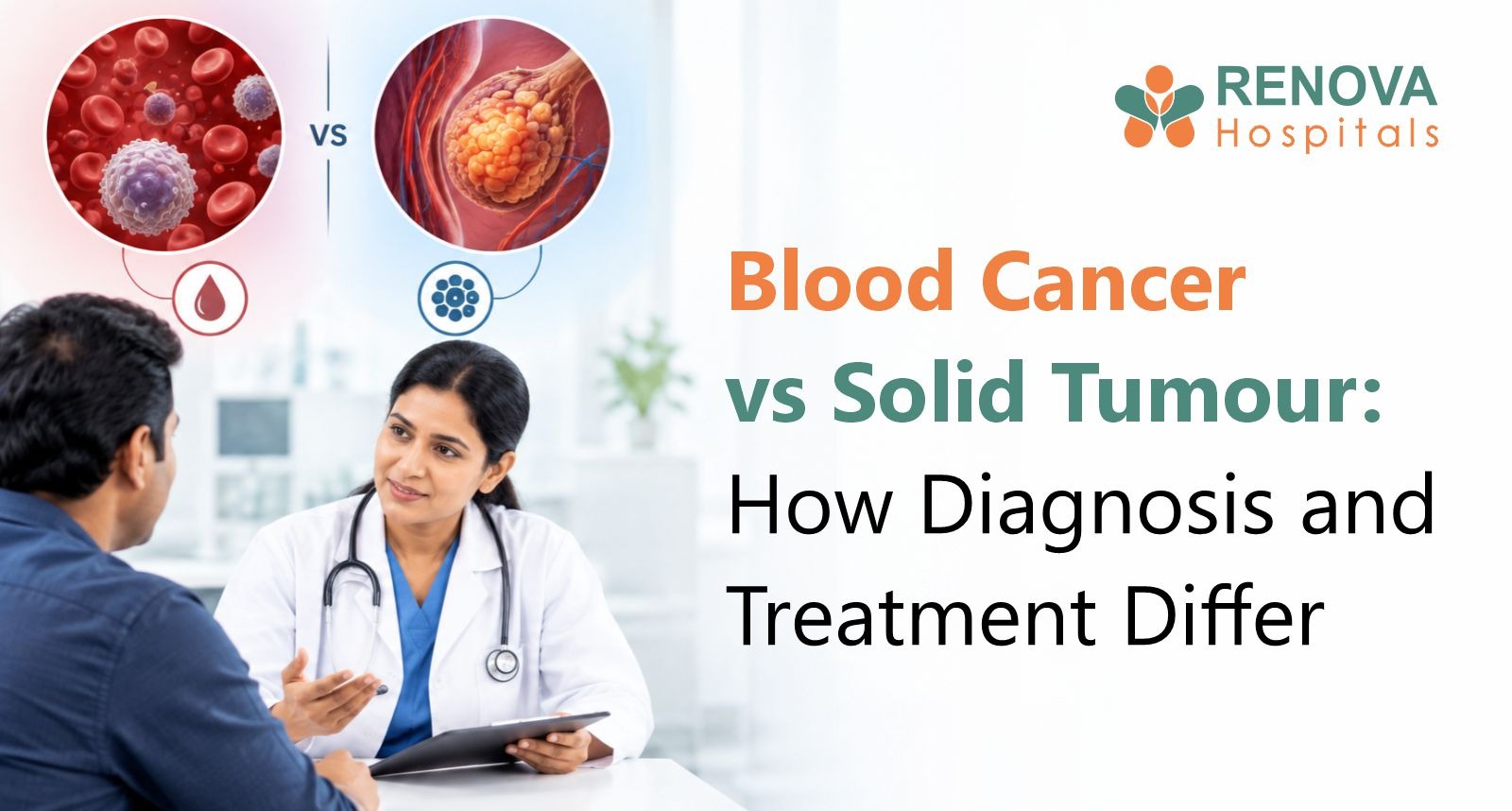
- Blood cancers start in the blood, bone marrow, or lymphatic system; solid tumours start in organs or tissues and form a mass.
- The three main blood cancer groups are leukaemia, lymphoma, and myeloma.
- Blood cancers are often diagnosed through blood tests, bone marrow biopsy, and lymph node biopsy.
- Solid tumours are usually found on imaging and confirmed by biopsy of the mass.
- Surgery and radiation play a central role in many solid tumours; medicines and stem cell transplant play a central role in many blood cancers.
- Staging works differently: solid tumours use stage systems based on size and spread, while blood cancers use disease-specific classification and risk groups.
- Some cancers, such as lymphoma, cross both categories because they can form lumps in lymph nodes.
- A specialist team, often reviewing the case together, decides the right plan for each individual.
What Is a Blood Cancer?
Blood cancer occurs when abnormal cells in the blood-forming system grow out of control. These cancers begin in the bone marrow, where blood cells are made, or in the lymphatic system, which is part of the body's immune defence.
The three main groups are:
- Leukaemia: cancer of blood-forming cells that start in the bone marrow and often spill into the bloodstream
- Lymphoma: cancer of lymphocytes, a type of white blood cell, which usually develops in the lymphatic system and can form lumps in lymph nodes
- Myeloma: cancer of plasma cells, a type of white blood cell made in the bone marrow
Because these cancers involve cells that travel through the blood and lymph, they are often present in many parts of the body from the start rather than confined to one spot.
What Is a Solid Tumour?
A solid tumour is an abnormal mass of tissue that begins in an organ or structure, such as the breast, lung, colon, liver, or brain. It generally does not contain fluid or cysts, which is where the name comes from.
Solid tumours begin in one place, called the primary site. If they spread, they may reach nearby lymph nodes or distant organs, and this pattern of spread helps doctors stage the cancer and plan treatment.
How Does Diagnosis Differ?
The tests used to confirm a diagnosis follow directly from where the cancer starts.
Diagnosing a Blood Cancer
- Blood tests, including a complete blood count, to look for abnormal cell numbers or appearance
- Bone marrow biopsy, to examine the marrow directly where blood cells are made
- Specialised laboratory tests on blood or marrow samples, such as flow cytometry and genetic or molecular testing, to identify the exact type and subtype
- Lymph node biopsy and imaging scans, particularly when lymphoma is suspected
Diagnosing a Solid Tumour
- Imaging such as ultrasound, CT, MRI, or PET-CT to locate the mass and see whether it has spread
- Biopsy of the mass, examined by a pathologist, to confirm that it is cancer and identify its type and grade
- Additional tests on the tissue, such as receptor or molecular testing, to guide targeted treatment
- Staging scans and tests to understand the full extent of disease
Do Blood Cancers Always Show Up on a Scan?
No.
Some blood cancers, particularly early leukaemia, may not form any visible mass at all, so the key information comes from blood and bone marrow tests rather than scans. Scans are still useful in lymphoma and myeloma to look for affected lymph nodes or bone changes.
How Does Staging Differ?
Staging describes how far a cancer has progressed, and the approach differs between the two groups.
Solid tumours are typically staged using the size of the tumour, whether nearby lymph nodes are involved, and whether the cancer has spread to distant organs. Many blood cancers are not staged in this way, because there may be no single tumour. Instead, doctors classify them by the specific type, subtype, genetic features, and risk group, and some, such as lymphoma, have their own staging systems based on how many areas of the body are involved.
How Does Treatment Differ?
Treatment is chosen to match how the cancer behaves, which is why the main tools differ.
Treatment of Solid Tumours
- Surgery to remove the tumour is often the central treatment when the cancer is localised
- Radiation therapy to treat the tumour area or reduce the risk of local recurrence
- Chemotherapy, targeted therapy, immunotherapy, or hormone therapy to treat cancer cells throughout the body
- Treatments are often combined and sequenced, for example medicine before or after surgery
Treatment of Blood Cancers
- Medicine-based treatment is usually the foundation, including chemotherapy, targeted therapy, and immunotherapy
- Stem cell or bone marrow transplant for selected patients, using the patient's own cells (autologous) or donor cells (allogeneic)
- Radiation therapy in selected situations, for example for certain lymphomas or as part of transplant preparation
- Close monitoring of blood counts and supportive care to manage infection risk and low blood counts during treatment
Is a Bone Marrow Transplant Only Used for Blood Cancers?
It is most often used for blood cancers, but not only.
Stem cell transplants are most often used for cancers that affect blood cells, such as leukaemia, lymphoma, multiple myeloma, and myelodysplastic syndromes. They are also used for certain other blood disorders, and in a small number of situations for selected other conditions. Whether a transplant is appropriate depends on the specific diagnosis, how the disease has responded to earlier treatment, and the patient's overall health.
Where the Two Groups Overlap
The line between the two groups is not always sharp.
- Lymphoma is classed as a blood cancer but often appears as swollen lymph nodes or masses that can be seen on scans
- Myeloma can cause bone lesions that look like discrete deposits on imaging
- Solid tumours can spread to the bone marrow, affecting blood counts
- Both groups are treated by medical oncologists, and many centres review complex cases together in a multidisciplinary tumour board
What Does This Mean for Prognosis?
There is no single answer, because outlook depends on the exact cancer type and subtype, the stage or risk group, the patient's age and general health, and how the disease responds to treatment.
Some blood cancers respond very well to modern treatment, while others are more difficult to control, and the same is true of solid tumours. Your treating oncologist can discuss outcome information specific to your diagnosis, which is far more meaningful than comparing the two groups as a whole.
Medical Review
Blood cancers and solid tumours differ in where they begin, how they are confirmed, how their extent is described, and which treatments form the foundation of care. Blood cancers are usually identified through blood, bone marrow, and lymph node tests and treated mainly with medicines and, for some patients, stem cell transplant, while solid tumours are usually identified on imaging and biopsy and often treated with a combination of surgery, radiation, and medicines.
In both groups, the right plan depends on the precise diagnosis, and careful evaluation by an experienced specialist team is the most important first step.
Consult the Oncology Team at Renova Hospitals
If you or a family member has been told you may have a blood cancer or a tumour, or you want a second opinion on a diagnosis, our oncology team can help you understand the type and the options.
Request a consultation or call 040 2333 3333.
Questions to Ask Your Oncology Team
- Is my diagnosis a blood cancer or a solid tumour, and what is the exact type?
- Which tests do I still need to confirm the type and extent of disease?
- Would stem cell transplant ever be part of my plan?
- Will my case be discussed by a multidisciplinary team?
Clear answers to these questions can help you understand the plan from the start.
The Bottom Line
Blood cancers begin in the blood, bone marrow, or lymphatic system, while solid tumours begin in organs and form a mass. This difference shapes how each is diagnosed, how its extent is described, and which treatments take the lead, with medicines and transplant central to many blood cancers and surgery and radiation central to many solid tumours.
At Renova Hospitals, our oncology teams evaluate each diagnosis individually, so that patients receive the plan that fits their specific type of cancer.
Medical References
Medically Reviewed & Approved By
Dr. Goli Vasu Babu
MBBS, DNB (General Medicine), DM (Medical Oncology)
Consultant Hemato-Oncologist and Bone Marrow Transplantation Physician, Renova Century Hospital and Renova NIGL Hospital, Banjara Hills, Hyderabad
This article has been reviewed and approved by a qualified medical professional to ensure medical accuracy and adherence to current clinical standards.