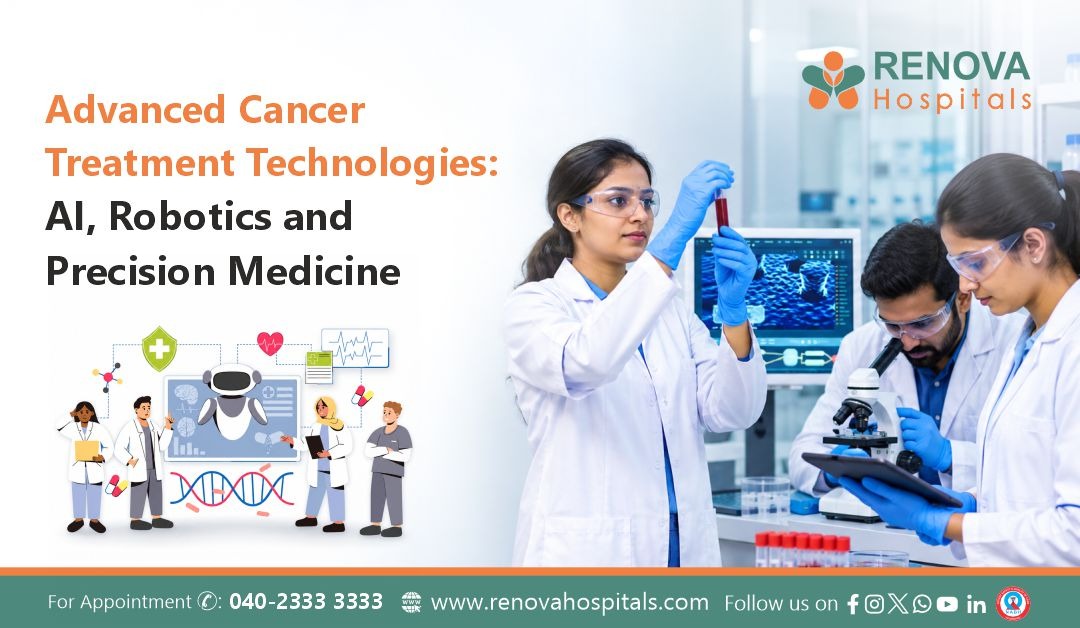
Cancer care has changed considerably over the past decade, driven by advances in technology that help doctors diagnose earlier, plan more precisely, and treat with greater accuracy. Three developments in particular,
artificial intelligence, robotics, and precision medicine, are reshaping how cancer is detected and managed. Understanding what these technologies actually do, and where they fit alongside the judgement of an experienced oncology team, can help patients make sense of the options available to them. This guide, reviewed by
Renova's oncology team, explains each of these technologies in plain terms.
Key Takeaways
- Artificial intelligence (AI) assists with analysing scans, pathology slides, and genomic data more quickly and consistently.
- Robotic-assisted surgery allows precise, minimally invasive removal of tumours in select cases.
- Precision medicine matches treatment to the genetic and molecular features of a patient's specific cancer.
- Genomic and biomarker testing can help identify whether targeted therapy or immunotherapy is likely to help.
- These technologies support, rather than replace, the clinical judgement of the oncology team.
- Not every patient or cancer type is suited to every technology; suitability is assessed case by case.
- Multidisciplinary tumour boards often use combined imaging, pathology, and genomic information to plan treatment.
- Access to a specific technology depends on the cancer type, stage, and what the treating team recommends.
Why Is Cancer Treatment Changing?
Cancer treatment has traditionally relied on surgery, chemotherapy, and radiation, chosen largely based on the type and stage of cancer. Advances in computing, imaging, and molecular biology now allow far more detailed information to be gathered about an individual tumour, and used to guide treatment decisions with greater precision.
This shift does not replace the fundamentals of cancer care. Rather, it gives oncology teams sharper tools for diagnosis, planning, and delivery, within the same framework of experienced clinical decision-making.
1. Artificial Intelligence (AI) in Cancer Care
AI refers to computer systems trained to recognise patterns in large amounts of data, and in oncology this is mainly used to support, not replace, specialist interpretation.
Current applications of AI in cancer care include:
- Assisting radiologists in detecting suspicious areas on scans such as mammograms, CT, and MRI
- Supporting pathologists in analysing tissue samples for cancer type and grade
- Helping to interpret complex genomic data to identify relevant mutations
- Assisting in treatment planning for radiation therapy, by helping to map treatment areas precisely
- Analysing patterns across large datasets to support research into new treatments
AI tools are generally used as a second layer of analysis alongside a specialist's own review, helping to flag findings for closer attention rather than making diagnostic or treatment decisions independently.
Does AI Replace the Doctor in Cancer Diagnosis?
No.
AI tools are designed to support radiologists, pathologists, and oncologists, not to replace their judgement. A specialist reviews the findings, considers the wider clinical picture, and makes the final diagnostic and treatment decisions. AI is best understood as an additional layer of consistency and speed, working alongside expert interpretation rather than instead of it.
2. Robotic-Assisted Surgery in Cancer Treatment
Robotic-assisted surgery uses a surgeon-controlled robotic system to perform operations through small incisions, offering enhanced precision, magnified 3D visualisation, and a greater range of motion than the human hand alone.
Potential benefits of robotic-assisted cancer surgery can include:
- Smaller incisions compared with traditional open surgery
- Reduced blood loss during certain procedures
- Potentially shorter hospital stays and faster recovery for suitable patients
- Greater surgical precision in anatomically complex or confined areas
Renova's
Robotic Surgery and
Surgical Oncology teams use these systems for select cancer types, including certain gastrointestinal, gynaecological, and urological cancers, where the technique is well suited to the individual case.
Is Robotic Surgery Better Than Traditional Surgery for Cancer?
It depends on the specific cancer, its location, and the individual patient.
Robotic-assisted surgery offers advantages in certain procedures, but it is not automatically superior for every case. Some tumours and situations are still best treated with traditional open surgery. Your surgical oncologist will recommend the approach best suited to your specific diagnosis, weighing precision, safety, and expected recovery.
3. Precision Medicine and Genomic Testing
Precision medicine, sometimes called personalised medicine, uses information about the genetic and molecular features of a patient's specific cancer to guide treatment choice, rather than relying only on the cancer's type and stage.
This approach typically involves:
- Genomic or biomarker testing of tumour tissue or blood to identify specific mutations
- Matching patients to targeted therapies designed to act on those specific mutations
- Identifying candidates for immunotherapy, based on markers that suggest a likely response
- Avoiding treatments unlikely to be effective for a specific tumour's molecular profile
Precision medicine does not apply to every cancer, and testing may not always change the treatment plan. However, for certain cancers, particularly lung, breast, and some blood cancers, it has become a standard part of treatment planning.
What Is the Difference Between Targeted Therapy and Immunotherapy?
Both are advanced treatments guided by precision medicine, but they work differently.
Targeted therapy uses drugs designed to act on specific molecules or mutations that drive a particular cancer's growth. Immunotherapy, by contrast, works by helping the body's own immune system recognise and attack cancer cells. Genomic and biomarker testing can help identify which patients are more likely to benefit from each approach.
Is Genomic Testing Necessary for All Cancer Patients?
No, it depends on the cancer type and clinical situation.
Genomic testing is more established and more likely to be recommended for certain cancers, such as lung cancer, breast cancer, and some blood cancers, where specific mutations are known to guide treatment choice. For other cancers, standard treatment protocols may already be well established without needing genomic testing. Your oncologist will advise whether testing is likely to be useful in your specific case.
How These Technologies Work Together
In practice, AI, robotics, and precision medicine often support different parts of the same overall treatment plan, rather than functioning as separate, unconnected options.
- AI-assisted imaging and pathology can help confirm an accurate diagnosis and stage
- Genomic testing can identify whether targeted therapy or immunotherapy is likely to help
- A multidisciplinary tumour board reviews this combined information to plan treatment
- Robotic-assisted surgery may be used where appropriate, as part of that treatment plan
This combined approach reflects a broader shift toward individualised cancer care, where technology enhances, but does not replace, coordinated decision-making by the oncology team.
Are These Technologies Right for Every Patient?
Not necessarily, and this is an important point for patients to understand.
Suitability for AI-assisted diagnostics, robotic surgery, or precision medicine testing depends on the specific cancer type, its stage, the patient's overall health, and what the evidence supports for that situation. These technologies are tools within a broader treatment plan, and your oncology team will advise which, if any, are relevant to your specific case.
Medical Review
Artificial intelligence, robotics, and precision medicine represent some of the most significant advances in cancer care in recent years. AI supports more consistent and rapid interpretation of scans and pathology, robotic-assisted surgery offers precise, minimally invasive treatment for select cases, and precision medicine allows treatment to be matched more closely to the biology of an individual tumour.
None of these technologies replace the expertise and judgement of an experienced oncology team. Instead, they provide sharper tools that, when used appropriately, can support more accurate diagnosis and more individualised treatment planning.
Consult the Oncology Team at Renova Hospitals
If you would like to understand whether advanced technologies such as precision medicine, genomic testing, or robotic-assisted surgery may be relevant to your specific diagnosis, our oncology team can help explain the options clearly.
At
Renova Hospitals, our
Medical Oncology,
Surgical Oncology, and
Radiation Oncology teams incorporate advanced diagnostic and treatment technologies where appropriate, guided by multidisciplinary tumour board planning.
Dr. Rama Vaghmare, Consultant Radiation Oncologist at Renova Century Hospital, whose clinical and research interests include precision oncology and AI in oncology, and the wider oncology team can help you understand which advanced approaches may be suitable for your case.
Request a consultation or call 040 2333 3333.
Questions to Ask Your Oncology Team
It can help to ask your care team directly:
- Is genomic or biomarker testing relevant for my specific cancer?
- Would robotic-assisted surgery be a suitable option in my case?
- How is AI used in the diagnostic process for my type of cancer?
- Are there targeted therapies or immunotherapy options that may apply to me?
Clear answers to these questions can help you understand how modern technology fits into your specific treatment plan.
The Bottom Line
Advanced cancer treatment technologies, AI, robotics, and precision medicine, are changing how cancer is diagnosed and treated, offering greater accuracy, precision, and individualisation than ever before. These tools work alongside, not instead of, the expertise of an experienced oncology team, and their relevance varies by cancer type, stage, and individual patient factors.
At Renova Hospitals, our oncology teams incorporate these advanced technologies where clinically appropriate, within a coordinated, multidisciplinary approach to cancer care.
Medical References
Medically Reviewed & Approved By:
Dr. Rama Vaghmare
MBBS, MD (NIMS), AMPH (ISB), FCPM, FAGE
Consultant Radiation Oncologist, Renova Century Hospital, Banjara Hills, Hyderabad
This article has been reviewed and approved by a qualified medical professional to ensure medical accuracy and adherence to current clinical standards.