Key Takeaways
- Upper GI endoscopy examines the oesophagus, stomach, and duodenum; colonoscopy examines the colon and rectum -- they are completely distinct procedures.
- Endoscopy is indicated for heartburn, dysphagia, upper abdominal pain, vomiting blood, or suspected peptic ulcer disease.
- Colonoscopy is indicated for rectal bleeding, altered bowel habits, colorectal cancer screening from age 45, or IBD surveillance.
- Both procedures are performed under sedation, are minimally invasive, and allow same-sitting biopsy and therapy.
- Colonoscopy preparation (bowel purgative) is more demanding and critical to diagnostic accuracy.
- Renova Institute of Gastro Sciences (RIGS) offers high-resolution endoscopy, colonoscopy, EUS, ERCP, capsule endoscopy, and advanced therapeutic procedures.
- Dr. Dheeraj Kumar Anupa, a specialist in therapeutic endoscopy, hepatology, and liver disease at Renova Century Hospital, leads gastroenterology services at RIGS.
What Is the Difference Between Endoscopy and Colonoscopy?
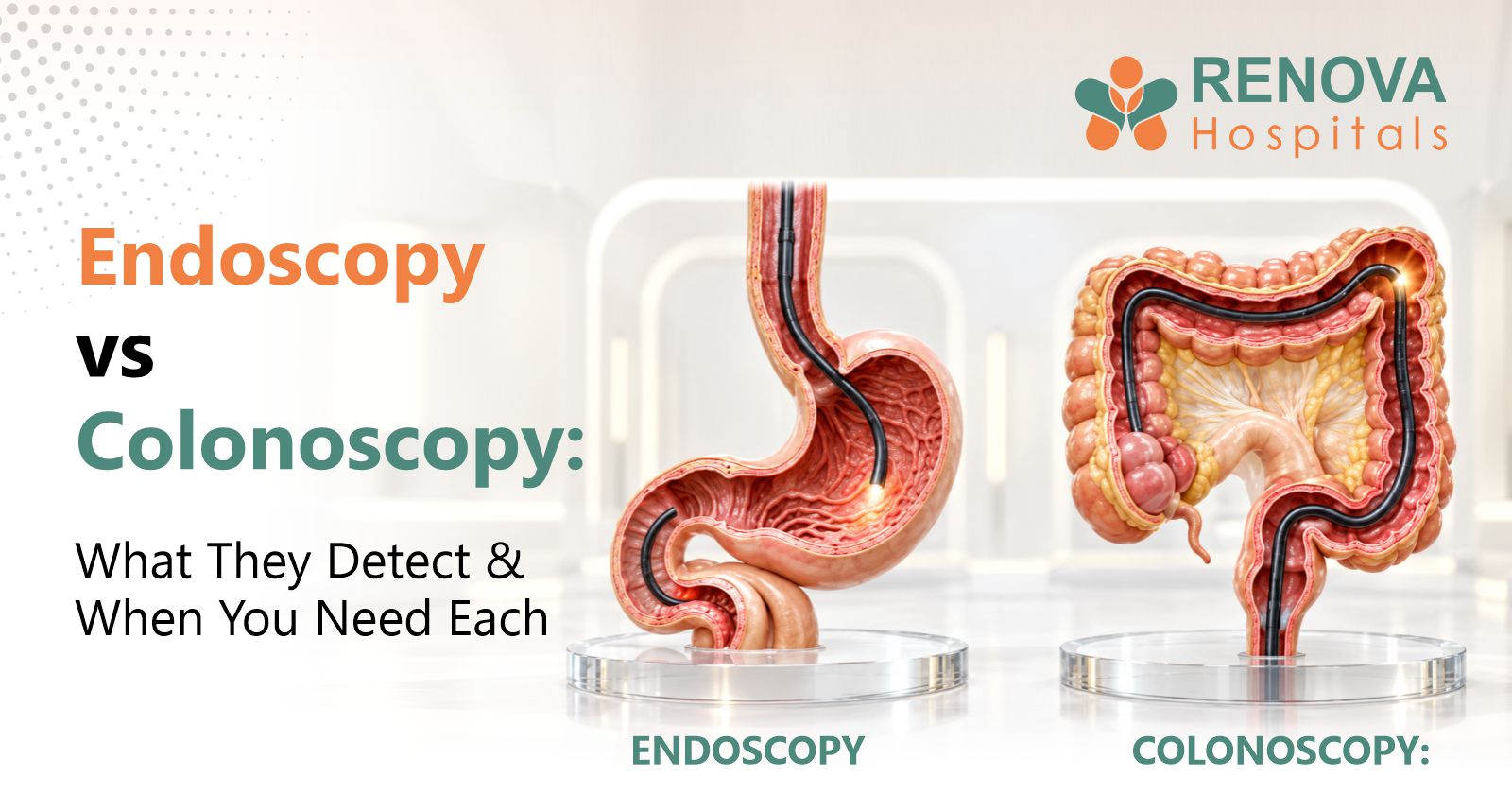
Endoscopy and colonoscopy are both procedures that use a long, thin, flexible tube equipped with a camera and light source to visualise the interior of the digestive tract. Despite the superficial similarity, they examine entirely different parts of the gastrointestinal (GI) system, are used for different indications, and require different preparations.
Understanding which procedure you need, what it will show, and how to prepare correctly can reduce unnecessary anxiety and ensure you are in the right diagnostic pathway from the outset.
What Is Upper GI Endoscopy?
Upper GI endoscopy -- also called oesophago-gastroduodenoscopy (OGD), gastroscopy, or simply endoscopy -- uses a flexible scope passed through the mouth (or, rarely, through the nose) to examine the oesophagus, stomach, and the first part of the small intestine (duodenum). It is the primary investigation for upper digestive tract symptoms.
What Is a Colonoscopy?
Colonoscopy uses a longer flexible scope introduced through the anus to examine the entire large intestine (colon and rectum) and, in some cases, the terminal ileum (end of the small bowel). It is the gold-standard investigation for colorectal symptoms, bowel cancer screening, and surveillance of inflammatory bowel disease (IBD) and polyps.
Sigmoidoscopy is a shorter version that examines only the lower third of the colon (sigmoid colon and rectum) and is sometimes used as a quicker screening or initial assessment tool.
What Does Endoscopy Detect?
Upper GI endoscopy can diagnose and, in many cases, treat a wide range of conditions:
- Gastro-oesophageal reflux disease (GERD) and Barrett's oesophagus: Chronic acid reflux can damage the oesophageal lining; Barrett's oesophagus is a precancerous change that requires endoscopic surveillance.
- Peptic ulcers: Ulcers in the stomach (gastric ulcers) or duodenum are among the most common endoscopy findings. H. pylori infection, a major cause, can be detected by biopsy at the same sitting.
- Oesophageal and gastric cancer: Endoscopy is the definitive diagnostic tool; biopsies confirm the diagnosis histologically.
- Oesophageal varices: Dilated veins in the oesophagus caused by portal hypertension in liver cirrhosis. Endoscopic variceal band ligation (EVL) can be performed therapeutically.
- Hiatus hernia.
- Coeliac disease: Duodenal biopsies show villous atrophy characteristic of gluten sensitivity.
- Upper GI bleeding: Identifies the source (ulcer, Mallory-Weiss tear, varix, angiodysplasia) and allows immediate haemostasis using endoscopic clips, injection therapy, or thermal coagulation.
- Dysphagia (difficulty swallowing): Detects structural causes including strictures, eosinophilic oesophagitis, and tumours.
- Foreign body removal and placement of feeding tubes.
What Does Colonoscopy Detect?
Colonoscopy is the most comprehensive examination of the large bowel and can both diagnose and treat many conditions:
- Colorectal cancer: Colonoscopy is the gold standard for early detection. India's colorectal cancer rates are rising, particularly in urban populations consuming a low-fibre, high-fat diet.
- Polyps: Precancerous growths on the colon lining (adenomas) can be removed at the time of the procedure (polypectomy), preventing cancer development.
- Inflammatory bowel disease (IBD): Crohn's disease and ulcerative colitis are visualised and confirmed by biopsy.
- Diverticular disease: Outpouchings of the colon wall that can become inflamed (diverticulitis) or bleed.
- Lower GI bleeding: Identifies sources such as angiodysplasia, polyps, haemorrhoids, or cancer.
- Irritable bowel syndrome (IBS) -- exclusion: Colonoscopy excludes organic pathology in patients with chronic bowel habit changes.
- Anal and rectal conditions: Haemorrhoids visible internally, rectal prolapse, rectal cancer.
- Stool surveillance: Biopsies guide treatment decisions in IBD.
When Do You Need Endoscopy vs Colonoscopy?
When Should You Have an Upper GI Endoscopy?
Your gastroenterologist is likely to recommend endoscopy in the following situations:
- Persistent heartburn or acid reflux not responding to medication (PPI therapy).
- Difficulty or pain on swallowing.
- Unexplained nausea, vomiting, or upper abdominal pain.
- Vomiting blood or passing black, tarry stools (melaena) -- an emergency indication.
- Unexplained iron-deficiency anaemia (to exclude upper GI blood loss).
- Suspected H. pylori infection or known ulcer disease requiring follow-up.
- Surveillance in patients with known Barrett's oesophagus or previous gastric surgery.
- Unexplained weight loss with upper GI symptoms.
When Should You Have a Colonoscopy?
- Rectal bleeding or blood mixed with stools.
- A change in bowel habits (persistent diarrhoea, constipation, or alternating pattern) lasting more than four weeks.
- Unexplained lower abdominal pain or cramping.
- Iron-deficiency anaemia without an obvious source (colonoscopy and endoscopy are often done together to evaluate both segments).
- Positive faecal occult blood test (FOBT) or faecal immunochemical test (FIT).
- Colorectal cancer screening: In individuals aged 45-50 and above without symptoms, or earlier in those with a first-degree family history of colorectal cancer or polyps.
- Surveillance after previous polyp removal or colorectal cancer treatment.
- Known IBD requiring disease assessment or dysplasia surveillance.
- Unexplained weight loss with lower GI symptoms.
How to Prepare for Each Procedure
How Do You Prepare for an Upper GI Endoscopy?
Preparation for upper GI endoscopy is straightforward:
- Fast for at least six hours before the procedure (usually overnight).
- Medications: Continue most regular medications with a small sip of water. Discuss blood thinners (aspirin, clopidogrel, warfarin, DOACs) and iron supplements with your doctor.
- Diabetic patients: Special fasting instructions apply; your gastroenterologist will advise on insulin and oral medication adjustments.
- Inform the team of any allergies, particularly to sedatives or latex.
How Do You Prepare for a Colonoscopy?
Colonoscopy preparation is more involved and critical to the quality of the examination:
- Bowel preparation (purgative): A laxative solution (polyethylene glycol or sodium phosphate-based) is taken the evening before and sometimes the morning of the procedure to completely empty the colon. Incomplete bowel prep reduces diagnostic accuracy and may necessitate a repeat procedure.
- Low-fibre diet: Eat only a low-residue diet two to three days before the procedure (no vegetables, fruits, seeds, nuts, or red meat).
- Clear fluids only on the day before.
- Medications: Stop iron supplements five days before. Blood thinners and antidiabetic drugs need specific adjustments.
- Arrive 30-60 minutes before your appointment for admission and intravenous cannula insertion.
What Happens During the Procedure?
What Happens During Endoscopy?
You will receive an intravenous sedative (propofol or midazolam with pethidine or fentanyl) that makes you sleepy and comfortable. A local anaesthetic throat spray reduces the gag reflex. The gastroenterologist passes the scope through the mouth, down the oesophagus and into the stomach and duodenum. The procedure typically takes 10-20 minutes for a diagnostic examination, longer if a therapeutic procedure (biopsy, band ligation, polyp removal) is performed.
What Happens During Colonoscopy?
Intravenous sedation is given. You lie on your left side. The colonoscope is gently guided through the anus to the caecum (beginning of the large bowel) and, when possible, into the terminal ileum. The bowel is insufflated with carbon dioxide gas to open the lumen. Total procedure time is 20-60 minutes depending on findings and any therapeutic interventions (polypectomy, biopsy, haemostasis).
What Are the Risks of Endoscopy and Colonoscopy?
Both procedures are safe when performed by experienced gastroenterologists but carry small risks:
- Bleeding: Occurs in fewer than 1 in 1000 diagnostic endoscopies and 1 in 500 colonoscopies; higher with therapeutic interventions such as polypectomy. Usually managed endoscopically.
- Perforation: Rare but serious. Risk is approximately 1 in 2000 for colonoscopy (higher with polypectomy) and 1 in 5000 for upper endoscopy.
- Sedation reactions: Cardiorespiratory events are rare; oxygen saturation and heart rate are monitored continuously.
- Post-procedural bloating and mild discomfort: Common and resolve within hours.
- Aspiration: Very rare during upper endoscopy in appropriately fasted patients.
At Renova Institute of Gastro Sciences (RIGS), high-resolution endoscopy and colonoscopy are performed with advanced imaging technology and experienced therapeutic endoscopists, minimising complication rates.
Advanced Endoscopic Procedures Available at Renova RIGS
Beyond standard diagnostic endoscopy and colonoscopy, Renova Institute of Gastro Sciences offers a range of advanced endoscopic services:
- Endoscopic retrograde cholangiopancreatography (ERCP): For bile duct and pancreatic duct conditions.
- Endoscopic ultrasound (EUS): Combines endoscopy and ultrasound for detailed imaging of GI wall layers, the pancreas, bile ducts, and submucosal lesions.
- Capsule endoscopy: The patient swallows a pill-sized camera that photographs the small bowel, which standard endoscopy and colonoscopy cannot reach.
- Endoscopic mucosal resection (EMR) and endoscopic submucosal dissection (ESD): Minimally invasive removal of larger polyps or early mucosal cancers.
- Variceal band ligation and sclerotherapy: Treatment of oesophageal and gastric varices in patients with liver cirrhosis.
- Balloon enteroscopy: Allows examination of the deep small bowel.
Medical References
- ASGE Standards of Practice Committee. Appropriate Use of GI Endoscopy. Gastrointestinal Endoscopy. 2012;75(6):1127-1131.
- Rex DK, Boland CR, Dominitz JA, et al. Colorectal Cancer Screening: Recommendations for Physicians and Patients from the U.S. Multi-Society Task Force on Colorectal Cancer. Gastroenterology. 2017;153(1):307-323.
- Indian Society of Gastroenterology. Consensus Guidelines on Colorectal Cancer Screening in India. Indian Journal of Gastroenterology. 2017;36(1):1-12.
- ESGE Guidelines on Upper GI Endoscopy for Screening and Surveillance. Endoscopy. 2019;51(4):365-388.
- Chandrasekhara V, Khashab MA, Muthusamy VR, et al. Adverse Events Associated with ERCP. Gastrointestinal Endoscopy. 2017;85(1):32-47.
Medically Reviewed & Approved By:
Dr. Dheeraj Kumar Anupa
MBBS, MD (General Medicine), DrNB (Medical Gastroenterology)
Consultant Medical Gastroenterologist, Hepatologist & Therapeutic Endoscopist
Renova Century Hospital, Banjara Hills, Hyderabad
This article has been reviewed and approved by a qualified medical professional to ensure medical accuracy and adherence to current clinical standards.