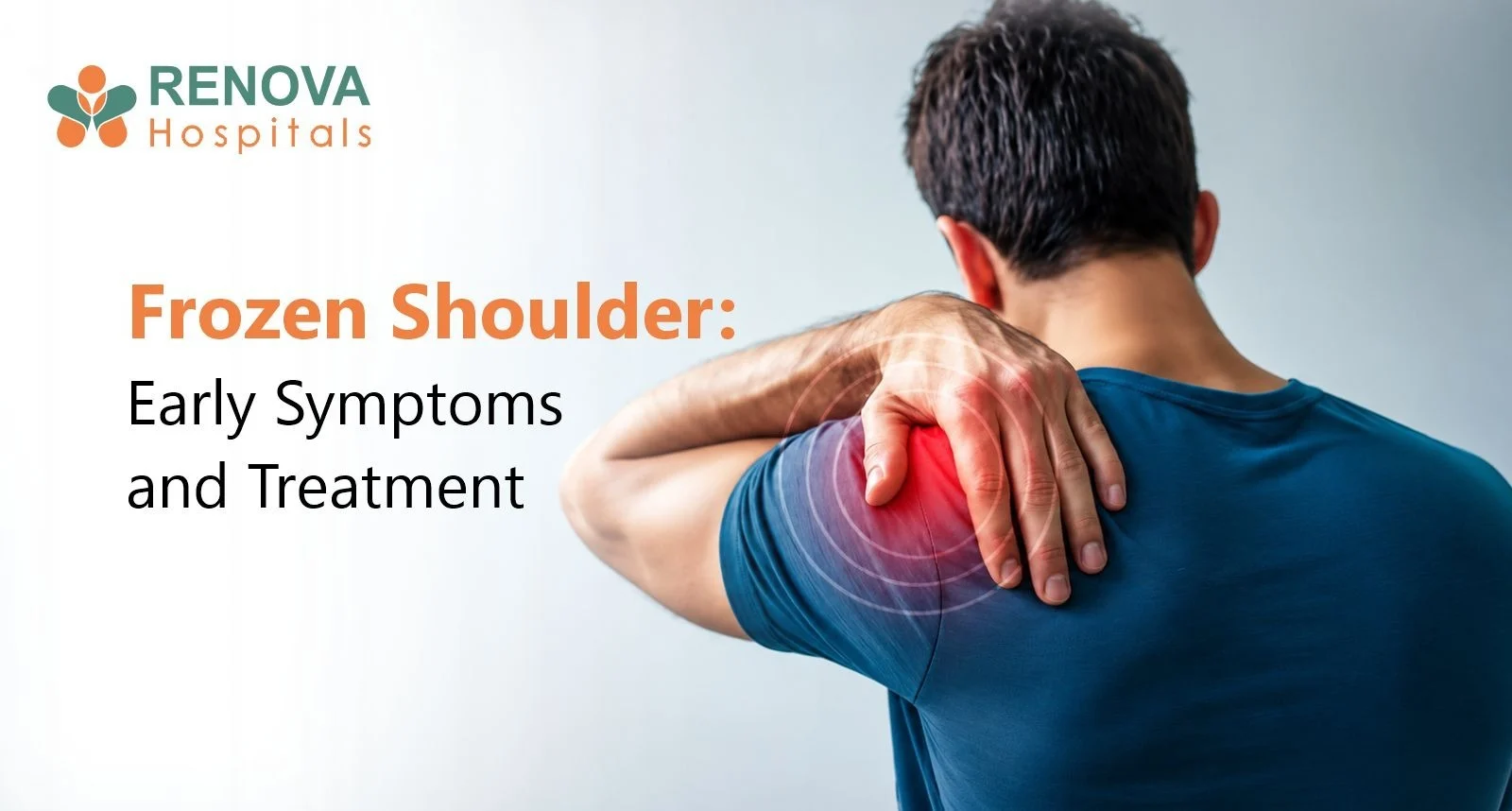
Frozen shoulder, medically called adhesive capsulitis, is a condition that causes progressive shoulder pain and stiffness. It develops when the capsule surrounding the shoulder joint becomes inflamed, thickened, and tight, restricting movement. Early symptoms often include pain while reaching overhead, behind the back, or while sleeping on the affected side. Treatment may include pain management, physiotherapy, stretching, corticosteroid injections in selected patients, and occasionally procedures or surgery when severe stiffness does not improve.
Key Takeaways
- Frozen shoulder causes both pain and progressive restriction of shoulder movement.
- Difficulty reaching behind the back is a common early complaint.
- Night-time shoulder pain may occur during the early stage.
- Diabetes and thyroid disorders are associated with an increased risk.
- Keeping the shoulder completely inactive may worsen stiffness.
- Physiotherapy and appropriate stretching are important parts of treatment.
- Corticosteroid injections may help selected patients, particularly during the painful stage.
- Recovery can take months and sometimes longer.
- Not every painful or stiff shoulder is frozen shoulder, so proper diagnosis matters.
What Is Frozen Shoulder?
Frozen shoulder is a painful condition in which movement of the shoulder gradually becomes restricted.
The shoulder is a ball-and-socket joint surrounded by connective tissue called the joint capsule.
In frozen shoulder, this capsule becomes inflamed and progressively thickens and tightens. Adhesions may develop within the capsule, reducing the space available for normal shoulder movement.
As a result, patients may gradually lose the ability to:
- Raise the arm overhead
- Reach behind the back
- Rotate the arm outward
- Dress comfortably
- Perform routine household activities
Unlike some shoulder conditions that mainly cause pain, frozen shoulder typically causes a noticeable loss of both active and passive movement.
What Are the Early Symptoms of Frozen Shoulder?
Frozen shoulder often begins gradually rather than after one obvious injury.
Early symptoms may include:
- Dull or aching shoulder pain
- Pain that becomes worse at night
- Difficulty sleeping on the affected shoulder
- Pain when reaching overhead
- Difficulty reaching behind the back
- Increasing difficulty wearing clothes
- Pain when putting on a shirt or jacket
- Difficulty combing or washing hair
- Gradual loss of shoulder movement
At first, pain may be more noticeable than stiffness.
As the condition progresses, restriction of movement becomes increasingly obvious.
What Does Frozen Shoulder Pain Feel Like
Pain is commonly described as a deep ache around the shoulder.
It may sometimes extend into the upper arm.
Pain can worsen with:
- Sudden movements
- Reaching overhead
- Reaching behind the body
- External rotation of the arm
- Sleeping on the affected side
Night pain can be particularly troublesome during the early inflammatory stage.
What Are the Three Stages of Frozen Shoulder?
Frozen shoulder typically progresses through three overlapping stages.
1. Freezing Stage
During the freezing or painful stage:
- Shoulder pain gradually increases.
- Night pain may become significant.
- Movement becomes progressively restricted.
- Everyday activities become increasingly difficult.
This phase may last for several months.
2. Frozen Stage
During this stage, pain may gradually reduce, but stiffness becomes the main problem.
Patients may have significant difficulty:
- Raising the arm
- Reaching behind the back
- Rotating the shoulder
- Dressing
- Performing overhead activities
3. Thawing Stage
During the thawing stage, shoulder movement gradually improves.
Recovery usually occurs slowly rather than suddenly.
The complete course can take many months, and some patients experience symptoms for considerably longer.
What Causes Frozen Shoulder?
The exact reason frozen shoulder develops is not always clear.
Some cases occur without an obvious trigger. This is sometimes called primary or idiopathic frozen shoulder.
Other cases develop after an injury, operation, illness, or period of reduced shoulder movement.
Possible risk factors include:
- Diabetes
- Thyroid disorders
- Shoulder injury
- Shoulder surgery
- Prolonged immobilisation
- Certain neurological conditions
- Other systemic medical conditions
Why Is Frozen Shoulder More Common in People With Diabetes?
People with
diabetes have a higher risk of developing frozen shoulder than people without diabetes.
Long-term changes in connective tissues associated with elevated blood glucose may contribute to stiffness and thickening of the shoulder capsule.
Frozen shoulder in people with diabetes may sometimes:
- Be more severe
- Last longer
- Affect both shoulders at different times
- Be more resistant to treatment
Good diabetes management is therefore an important part of overall health in patients with frozen shoulder.
However, having frozen shoulder does not automatically mean a person has diabetes.
Are Thyroid Disorders Linked to Frozen Shoulder?
Research has also identified an association between frozen shoulder and certain
thyroid disorders.
Depending on the patient's symptoms and medical history, a doctor may consider whether evaluation for diabetes or thyroid dysfunction is appropriate.
Routine testing is not necessarily required for every person with
shoulder pain.
Can Frozen Shoulder Develop After an Injury or Surgery?
Yes.
Frozen shoulder may develop after:
- Shoulder injury
- Fracture
- Rotator cuff injury
- Shoulder surgery
- Other upper-limb surgery
- A period when the arm has remained relatively immobile
Reduced movement can contribute to progressive stiffness in susceptible individuals.
This is one reason appropriate rehabilitation after injury or surgery is important.
Is Frozen Shoulder the Same as a Rotator Cuff Injury?
No.
A
rotator cuff injury affects the muscles and tendons that help stabilise and move the shoulder.
Rotator cuff problems may cause:
- Shoulder pain
- Weakness
- Difficulty lifting the arm
- Night pain
Frozen shoulder primarily involves tightening and inflammation of the shoulder capsule.
One important clinical distinction is that frozen shoulder typically restricts both active movement and movement when someone else tries to move the shoulder.
A clinical examination helps distinguish between these conditions.
Is Frozen Shoulder the Same as Shoulder Arthritis?
No.
Both arthritis and frozen shoulder can cause:
- Pain
- Stiffness
- Reduced movement
However, their underlying causes and treatment approaches differ.
Imaging may be recommended when arthritis or another structural problem is suspected.
How Is Frozen Shoulder Diagnosed?
Frozen shoulder is primarily a clinical diagnosis.
An orthopaedic doctor usually asks about:
- When symptoms started
- Whether there was an injury
- Night pain
- Diabetes
- Thyroid disease
- Previous surgery
- Activities that have become difficult
The shoulder is then examined.
Active Movement
The patient moves the shoulder independently.
Passive Movement
The doctor gently moves the patient's shoulder.
Restriction of both active and passive movement—particularly external rotation—is an important feature of frozen shoulder.
Do You Need an X-Ray or MRI for Frozen Shoulder?
Not every patient requires an MRI.
X-Ray
An X-ray may be used to exclude conditions such as:
- Arthritis
- Previous fracture
- Certain bone abnormalities
MRI
MRI may be considered when doctors suspect another condition, such as:
- Rotator cuff tear
- Tendon injury
- Other soft-tissue abnormalities
How Is Frozen Shoulder Treated?
Treatment depends on:
- Stage of the condition
- Severity of pain
- Degree of stiffness
- Duration of symptoms
- Underlying medical conditions
- Response to previous treatment
Most patients are initially treated without surgery.
1. Pain Management
Pain relief may help patients remain active and participate in rehabilitation.
Depending on individual health and medical history, a doctor may recommend appropriate pain-relieving or anti-inflammatory medication.
Patients should avoid prolonged self-medication, particularly if they have kidney disease, stomach ulcers, heart disease, or take blood-thinning medicines.
2. Physiotherapy
Physiotherapy is an important part of frozen shoulder management.
Treatment may focus on:
- Gentle stretching
- Improving range of motion
- Maintaining shoulder mobility
- Gradually restoring function
- Strengthening when appropriate
The exercise programme should match the stage and severity of the condition.
Aggressive stretching during a highly painful stage can sometimes worsen symptoms.
3. Home Shoulder Exercises
A physiotherapist or orthopaedic doctor may recommend exercises that can be performed regularly at home.
These may include gentle:
- Pendulum exercises
- Assisted forward elevation
- External rotation stretches
- Cross-body stretches
Exercises should be performed within appropriate limits.
Severe pain during exercise is not necessarily a sign that the treatment is working.
4. Corticosteroid Injection
A corticosteroid injection into the shoulder joint may reduce pain and inflammation in selected patients, particularly during the earlier painful stage.
Reducing pain may also make physiotherapy and stretching easier.
The benefits and risks should be discussed with the treating doctor, particularly in people with diabetes because corticosteroids can temporarily increase blood glucose.
5. Hydrodilatation
Hydrodilatation, sometimes called joint distension, involves injecting fluid into the shoulder joint under imaging guidance to stretch the tight capsule.
It may be considered for selected patients who continue to experience significant stiffness.
Not everyone with frozen shoulder requires this procedure.
6. Manipulation Under Anaesthesia
In selected resistant cases, the shoulder may be gently moved through its range while the patient is under anaesthesia.
This aims to stretch or release the tight capsule.
Because complications are possible, manipulation is reserved for appropriately selected patients.
7. Arthroscopic Capsular Release
Surgery is rarely the first treatment for frozen shoulder.
For persistent severe stiffness that does not improve with appropriate non-surgical management,
shoulder arthroscopy may be considered.
During arthroscopic capsular release, the surgeon releases tight portions of the shoulder capsule to improve movement.
Rehabilitation after the procedure remains important.
Can Frozen Shoulder Heal Without Surgery?
Yes.
Most cases can be managed without surgery.
Frozen shoulder is often described as a self-limiting condition because movement can gradually improve over time.
However, "self-limiting" does not mean patients should simply ignore severe pain and stiffness.
Appropriate treatment can:
- Reduce pain
- Maintain movement
- Improve daily function
- Guide safe rehabilitation
- Identify other causes of shoulder symptoms
How Long Does Frozen Shoulder Take to Recover?
Recovery varies significantly.
Some patients improve over several months, while others may experience symptoms for a year or longer.
Recovery depends on:
- Severity
- Stage at diagnosis
- Diabetes or other medical conditions
- Adherence to rehabilitation
- Individual response to treatment
Improvement is often gradual.
Can Frozen Shoulder Come Back?
Frozen shoulder usually does not repeatedly affect the exact same shoulder after complete recovery, but some people may later develop the condition in the opposite shoulder.
The risk may be higher in people with diabetes or other associated medical conditions.
Can You Exercise With Frozen Shoulder?
Usually yes, but the exercises need to be appropriate.
Complete inactivity can contribute to further stiffness.
At the same time, aggressive or painful exercises can irritate an already inflamed shoulder.
A balanced rehabilitation programme typically involves controlled stretching and progressive movement based on the stage of the condition.
What Should You Avoid With Frozen Shoulder?
Avoid:
- Completely immobilising the shoulder without medical advice
- Aggressive stretching through severe pain
- Heavy overhead lifting during a painful flare
- Sudden jerking movements
- Repeatedly forcing the arm behind the back
- Depending only on massage without addressing restricted joint movement
- Delaying evaluation when weakness is significant
- Assuming every stiff shoulder is frozen shoulder
- Continuing exercises that consistently produce severe or worsening pain
Medical Review
Frozen shoulder usually develops gradually and progresses through painful, stiff, and recovery phases.
Early recognition can help patients manage pain, maintain safe movement, and begin appropriate rehabilitation.
Because rotator cuff injuries, arthritis, cervical spine problems, and other shoulder conditions can cause similar symptoms, persistent shoulder pain and stiffness should be properly evaluated before starting an intensive exercise programme.
Consult an Orthopaedic Team at Renova Hospitals
Shoulder pain that gradually progresses into stiffness can interfere with dressing, sleeping, driving, working, and everyday activities.
At
Renova Hospitals, our
Orthopaedics and Shoulder specialists evaluate frozen shoulder and other causes of shoulder pain to determine the appropriate combination of pain management, physiotherapy, injections, rehabilitation, or surgical treatment when required.
Request a consultation or call 040 2333 3333.
Need Medical Guidance?
Consult Renova Orthopaedics if you experience:
- Persistent shoulder pain
- Increasing shoulder stiffness
- Difficulty raising your arm
- Difficulty reaching behind your back
- Night-time shoulder pain
- Shoulder symptoms after an injury or surgery
- Shoulder pain associated with significant weakness
Early assessment can help distinguish frozen shoulder from rotator cuff injury, arthritis, tendon problems, and other causes of shoulder pain.
When Does Shoulder Pain Need Urgent Care?
Seek prompt medical attention if shoulder pain occurs with:
- A significant fall or injury
- Visible shoulder deformity
- Sudden inability to move the arm after trauma
- Severe swelling
- Redness and fever
- New arm numbness or marked weakness
- A cold, pale, or blue hand
- Severe chest pressure, sweating, breathlessness, or pain spreading from the chest to the shoulder or arm
Shoulder or arm discomfort accompanied by chest symptoms may sometimes be related to a
heart attack and requires emergency assessment.
Early Treatment Can Make Frozen Shoulder Easier to Manage
Frozen shoulder can be frustrating because recovery is often gradual, but most patients improve with time and appropriate treatment.
The goal is to control pain, preserve safe movement, progressively restore shoulder function, and identify medical factors such as diabetes that may influence recovery.
At Renova Hospitals, our Orthopaedics and rehabilitation teams provide personalised assessment and treatment for frozen shoulder and other shoulder conditions.
Medical References
Medically Reviewed & Approved By:
Dr. Anoop Reddy Sama
MS Orthopedics, Fellowship in Shoulder Surgery (France), Fellowship in Sports Injuries – Consultant Shoulder & Sports Surgeon
This article has been reviewed and approved by a qualified medical professional to ensure medical accuracy and adherence to current clinical standards.