Renova Hospitals Logo
Home Blogs Knee Swelling After Walking: Possible Causes
Common reasons for swollen knees after walking

By Dr. Radhakrishna Rao Sagi

September 14, 2026

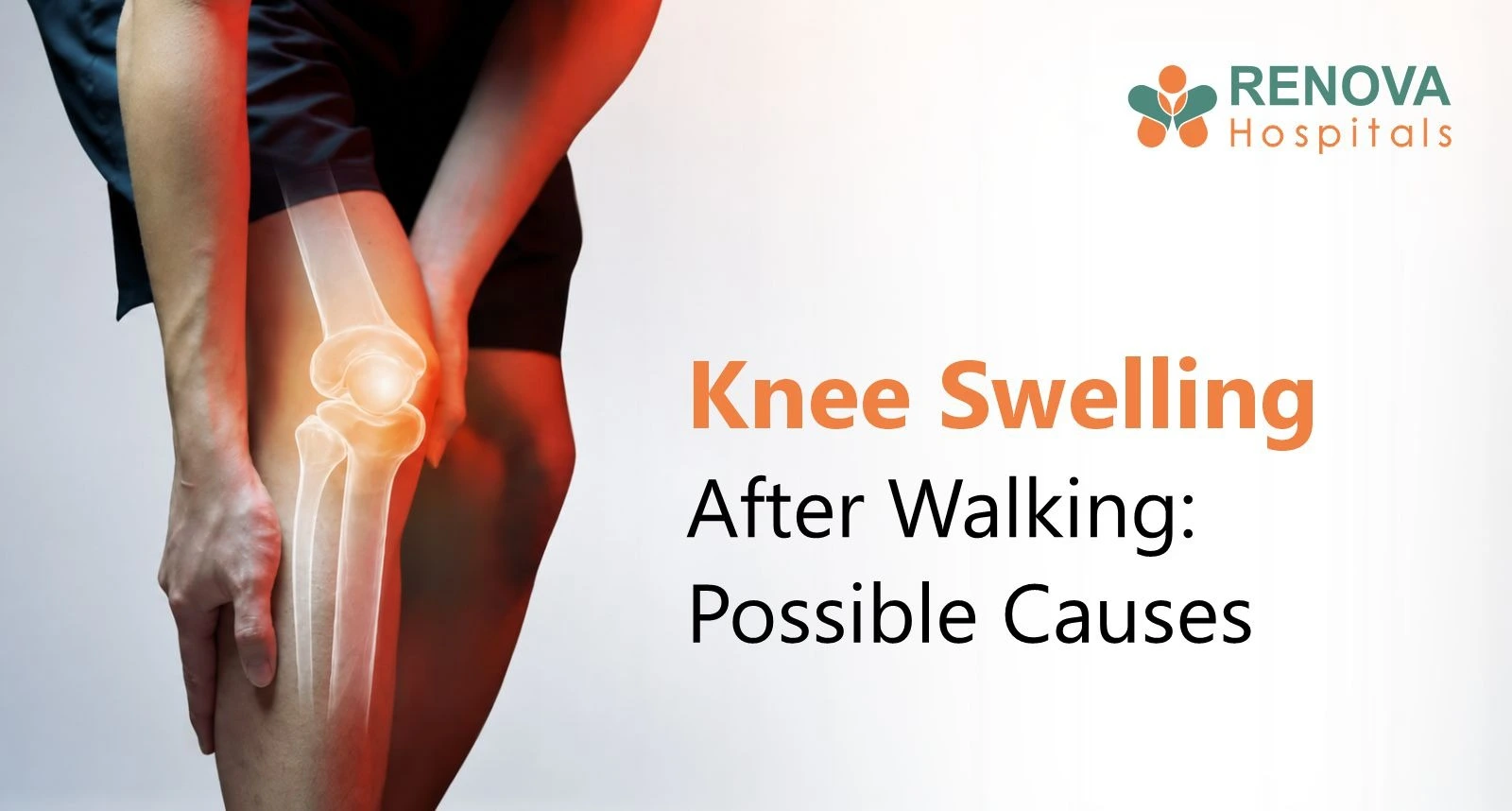
Knee Swelling After Walking: Possible Causes

Knee swelling after walking may occur when excess fluid accumulates in or around the knee joint because of overuse, osteoarthritis, a meniscus or ligament injury, bursitis, gout, or another inflammatory condition. Mild swelling after unusually strenuous activity may settle with rest, but recurrent swelling, inability to bear weight, joint locking, significant redness or warmth, fever, or swelling after an injury requires medical evaluation.

Key Takeaways

  • Repeated knee swelling after ordinary walking should not automatically be considered normal ageing.
  • Osteoarthritis is a common cause of activity-related knee pain and swelling.
  • Meniscus injuries can cause swelling, catching, or locking.
  • Bursitis can produce localised swelling around the knee.
  • Gout can cause sudden severe pain, redness, warmth, and swelling.
  • A hot, swollen knee with fever may indicate joint infection and needs urgent evaluation.
  • Treatment depends on the underlying cause rather than swelling alone.
  • Persistent swelling may require examination, X-ray, ultrasound, MRI, or joint-fluid analysis.

What Causes Knee Swelling?


The knee contains structures including:

  • Bone
  • Cartilage
  • Menisci
  • Ligaments
  • Tendons
  • Bursae
  • Synovial lining

Swelling can develop when one or more of these structures becomes irritated, inflamed, or injured.

Fluid accumulating inside the knee joint is sometimes called a knee effusion.

1. Knee Osteoarthritis

Knee osteoarthritis is a common cause of knee pain and activity-related stiffness.

Symptoms may include:

  • Pain during walking
  • Stiffness after rest
  • Swelling
  • Reduced movement
  • Grinding or creaking sensations

Symptoms may become more noticeable after:

  • Long walks
  • Climbing stairs
  • Prolonged standing
  • Repetitive loading

Osteoarthritis is more than simply "wear and tear"; it involves changes affecting the whole joint.

2. Meniscus Injury

The meniscus is a cartilage structure that helps distribute load within the knee.

A meniscus tear can occur after twisting or may develop gradually with age-related tissue changes.

Symptoms can include:

  • Joint-line pain
  • Swelling
  • Catching
  • Clicking
  • Difficulty fully straightening the knee
  • Locking

Swelling may appear after activity rather than immediately.

3. Ligament Injury

Ligaments stabilise the knee.

Injuries such as an ACL tear may occur during sports, sudden twisting, or trauma.

A significant ligament injury can cause:

  • Rapid swelling
  • Pain
  • Instability
  • A sensation that the knee is giving way

Swelling after a clear twisting injury should be assessed, particularly when walking is difficult.

4. Knee Bursitis

Bursitis occurs when a small fluid-filled sac around the knee becomes inflamed.

Depending on the bursa involved, swelling may be more localised than swelling caused by fluid inside the joint.

Bursitis can occur after:

  • Repetitive pressure
  • Prolonged kneeling
  • Trauma
  • Certain inflammatory conditions

5. Gout

Gout is an inflammatory arthritis caused by urate crystal deposition.

Although the big toe is a classic location, gout can also affect the knee.

An attack may cause:

  • Sudden severe pain
  • Marked swelling
  • Redness
  • Warmth
  • Extreme tenderness

A first episode of a severely swollen joint should be properly evaluated because infection can sometimes produce similar symptoms.

6. Rheumatoid Arthritis

Rheumatoid arthritis is an autoimmune inflammatory disease that can affect multiple joints.

Symptoms may include:

  • Joint swelling
  • Morning stiffness
  • Pain
  • Warmth
  • Symptoms affecting both sides of the body

Persistent swelling involving multiple joints requires medical assessment.

7. Joint Infection

Septic arthritis occurs when a joint becomes infected.

Symptoms may include:

  • Severe pain
  • Rapid swelling
  • Warmth
  • Redness
  • Fever
  • Difficulty moving the joint

A suspected joint infection is an urgent medical condition.

Delayed treatment can damage cartilage and other joint structures.

Can Too Much Walking Cause Knee Swelling?


A sudden increase in walking distance can temporarily irritate knee tissues, particularly if a person is not accustomed to that activity.

However, ordinary walking should not repeatedly produce substantial swelling in a healthy knee.

Recurrent swelling may indicate an underlying problem such as:

  • Osteoarthritis
  • Meniscus injury
  • Tendon irritation
  • Bursitis
  • Inflammatory arthritis

Is Knee Swelling a Sign of Arthritis?


It can be, but not always.

Both osteoarthritis and inflammatory forms of arthritis can cause swelling.

Doctors consider:

  • Age
  • Pain pattern
  • Morning stiffness
  • Injury history
  • Number of joints affected
  • Examination findings

Imaging or blood tests may be recommended depending on the suspected cause.

What Can You Do for Mild Knee Swelling?


For mild symptoms following increased activity, short-term measures may include:

  • Reducing aggravating activity
  • Applying a cold pack for short intervals
  • Elevating the leg
  • Gradually returning to activity

Pain medicines should be used according to medical advice, particularly in people with kidney, heart, or stomach problems.

Should You Stop Walking?


Not necessarily.

Complete inactivity can lead to muscle weakness and reduced joint function.

For many chronic knee conditions, appropriately dosed exercise is beneficial.

However, walking through significant pain and swelling is not necessary.

Activity may need to be temporarily modified while the cause is assessed.

How Is Persistent Knee Swelling Diagnosed?


Depending on symptoms, evaluation may include:

Physical Examination

The doctor assesses:

  • Swelling
  • Tenderness
  • Movement
  • Stability
  • Meniscus signs
  • Walking pattern

X-Ray

Useful for evaluating:

  • Osteoarthritis
  • Fracture
  • Bone alignment

MRI

May be useful when a meniscus, ligament, cartilage, or another soft-tissue injury is suspected.

Joint Fluid Analysis

A needle may be used to remove fluid from a significantly swollen joint.

Testing can help investigate:

  • Infection
  • Gout
  • Other inflammatory causes

What Should You Avoid?


  • Continuing strenuous walking despite increasing swelling
  • Aggressive massage of an acutely swollen joint
  • Self-diagnosing every swollen knee as arthritis
  • Taking repeated painkillers without evaluation
  • Ignoring locking or instability
  • Ignoring fever with a hot swollen knee
  • Using steroid injections without a proper diagnosis

Consult Orthopaedics at Renova Hospitals


Recurring knee swelling can indicate more than simple overuse.

At Renova Hospitals, our Orthopaedic and Joint Replacement specialists evaluate knee pain and swelling to identify conditions such as osteoarthritis, meniscus injury, ligament damage, bursitis, and other joint disorders.

Request a consultation or call 040 2333 3333.

When Does Knee Swelling Need Urgent Care?


Seek urgent assessment for:

  • A hot, red, severely painful knee
  • Fever with joint swelling
  • Inability to bear weight after injury
  • Significant deformity
  • Rapid swelling after trauma
  • Severe pain with loss of movement
  • A cold, pale, or numb foot after injury

Medical References


Medically Reviewed & Approved By:

Dr. Radhakrishna Rao Sagi
MBBS, Diploma in Orthopaedics, DNB (Orthopaedics/Orthopaedic Surgery) – Senior Orthopaedic Surgeon

This article has been reviewed and approved by a qualified medical professional to ensure medical accuracy and adherence to current clinical standards.

Want to connect with a specialist?

Book your appointment now

Our Panel of Doctors

Our healthcare specialists are equipped with the knowledge and skills to provide you with the support you require. From consultation to diagnosis to treatments, our experts are dedicated to helping you.

Dr. Radhakrishna Rao Sagi - Best doctor at Renova Hospitals

Dr. Radhakrishna Rao Sagi

Orthopaedics

27 years Experience

English, Hindi, Telugu

Renova Neelima Hospital - Sanath Nagar

MBBS – Dr. NTR University of Health Sciences (1998...

Recent Blogs

Our healthcare specialists are equipped with the knowledge and skills to provide you with the support you require. From consultation to diagnosis to treatments, our experts are dedicated to helping you.

Role of AI and robotics in advanced cancer treatment
Radiation Oncology

Advanced Cancer Treatment Technologies: AI, Robotics and Precision Medicine

30 September 2026 | By Dr. Rama Vaghmare

Explore how AI, robotic surgery, and precision medicine are advancing cancer care through more personalised diagnosis, t...

Multidisciplinary approach to cancer diagnosis and treatment
Surgical Oncology

Tumour Board Approach in Cancer Care: Why Multiple Specialists Matter

28 September 2026 | By Dr. Srinivas Juluri

Understand how a tumour board brings together multiple cancer specialists to review complex cases, discuss treatment opt...

Understanding the duration and stages of cancer treatment
Radiation Oncology

How Long Does Cancer Treatment Take? Understanding Treatment Timelines

25 September 2026 | By Dr. Sandeep Kumar Tula

Understand how long cancer treatment may take, the different stages involved, and the factors that can influence an indi...

Post-cancer treatment care – recovery and survivorship
Medical Oncology

Life After Cancer Treatment: Follow-Up Care, Recovery and Survivorship

23 September 2026 | By Dr. Rajesh Bollam

Learn about life after cancer treatment, including follow-up care, recovery, managing long-term effects, and staying hea...

Understanding cancer recurrence after successful treatment
Medical Oncology

Cancer Recurrence: Why Does Cancer Come Back After Treatment?

21 September 2026 | By Dr. Rajesh Bollam

Understand why cancer may recur after treatment, the factors that can contribute to recurrence, and the importance of re...

Importance of a second opinion in cancer treatment
Medical Oncology

Second Opinion in Cancer Treatment: When Should Patients Seek One?

18 September 2026 | By Dr. Rajesh Bollam

Understand when seeking a second opinion in cancer treatment can help patients make informed decisions about diagnosis,...

Frequently Asked Questions

Find quick answers to common questions about our services, doctors, and care at Renova Hospitals. So you can feel informed and confident at every step.

Why does my knee swell after a long walk?

Is knee swelling after walking normal?

Can arthritis cause swelling after walking?

Can a meniscus tear cause swelling?

Should I use ice for a swollen knee?

Can I exercise with a swollen knee?

When should I see an orthopaedic doctor?

Call Us Request a
Callback
WhatsApp


Corporate Office

Plot No. 270/A, Padmaja Tower, 2nd Floor, MLA Colony, Road No. 12, Banjara Hills, Hyderabad - 500034

Phone: 040 2333 3333