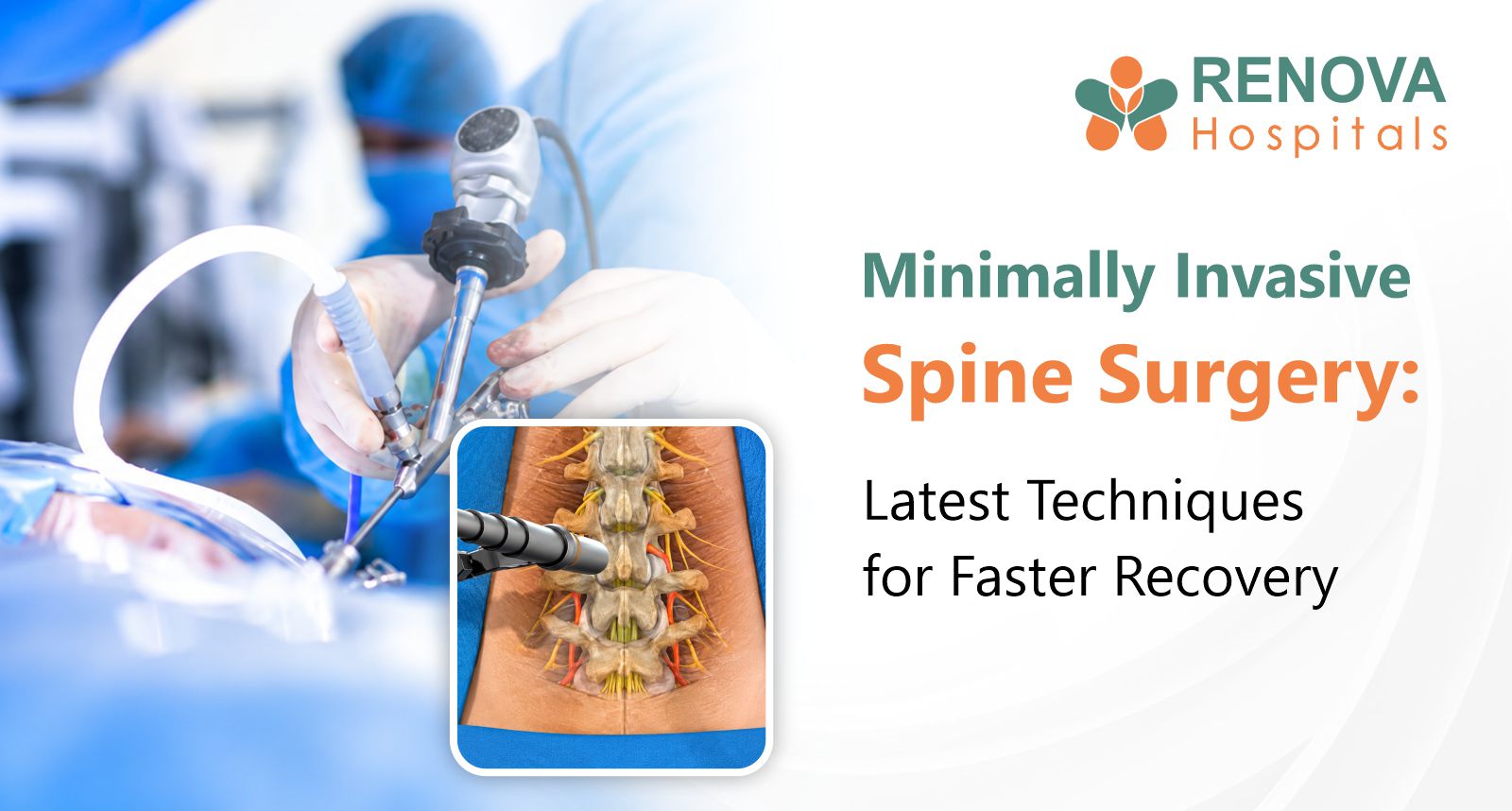
Spine surgery has traditionally involved larger incisions and significant muscle disruption to access the spine.
Minimally invasive spine surgery uses smaller incisions, specialised instruments, and often an endoscope or microscope to treat many of the same conditions, generally with less tissue damage and a faster path to recovery. Understanding the latest techniques, who is a suitable candidate, and what recovery looks like can help patients considering spine surgery make a more informed decision. This guide, reviewed by
Renova's neurosurgery team, explains minimally invasive spine surgery in clear, practical terms.
Key Takeaways
- Minimally invasive spine surgery uses smaller incisions and specialised instruments compared with traditional open surgery.
- Common techniques include tubular retractor systems, endoscopic spine surgery, and minimally invasive fusion procedures.
- It is generally used for conditions such as herniated discs, spinal stenosis, and certain degenerative spine conditions.
- Benefits for suitable patients often include less blood loss, reduced post-operative pain, and a shorter hospital stay.
- Not every spine condition or patient is suited to a minimally invasive approach; suitability is assessed individually.
- Recovery is generally faster than open surgery, though it still requires structured rehabilitation.
- An experienced spine surgery team improves both surgical precision and recovery outcomes.
- The right technique depends on the specific diagnosis, spinal level involved, and overall health of the patient.
What Is Minimally Invasive Spine Surgery?
Minimally invasive spine surgery (MISS) refers to a range of surgical techniques that treat spine conditions through small incisions, using specialised instruments and, in many cases, an endoscope or microscope for visualisation, rather than the larger incisions and extensive muscle dissection used in traditional open spine surgery.
Rather than cutting through large amounts of muscle to reach the spine, surgeons use tubular retractors or endoscopic ports to work through a small opening, guided by imaging and specialised visualisation tools.
Latest Techniques in Minimally Invasive Spine Surgery
Several specific techniques fall under the umbrella of minimally invasive spine surgery, each suited to different conditions.
Endoscopic Spine Surgery
- Uses a small camera (endoscope) inserted through a tiny incision to visualise the spine in detail
- Allows surgeons to remove herniated disc material or bone spurs with minimal disruption to surrounding tissue
- Often performed for conditions such as disc herniation and certain cases of spinal stenosis
- Generally associated with very small incisions and, for suitable cases, quicker recovery
Tubular Retractor Microdiscectomy
- Uses a narrow tubular retractor to create a small working channel to the spine
- Commonly used to remove herniated disc material pressing on a nerve
- Reduces muscle disruption compared with traditional open discectomy
Minimally Invasive Spinal Fusion
- Joins two or more vertebrae together to stabilise the spine, using smaller incisions and specialised instruments
- Often used for conditions involving spinal instability, such as spondylolisthesis
- Can involve techniques such as minimally invasive TLIF (transforaminal lumbar interbody fusion)
Is Laser Spine Surgery the Same as Minimally Invasive Spine Surgery?
Not exactly. "Laser spine surgery" is a marketing term that is sometimes used loosely, and it does not describe a single, distinct surgical technique.
In practice, lasers may occasionally be used as one tool within a broader minimally invasive or endoscopic procedure, but the outcome depends far more on the surgical approach and the surgeon's technique than on whether a laser is specifically used. It is more useful to ask about the specific technique planned, such as endoscopic discectomy or tubular microdiscectomy, than to focus on the term "laser surgery" alone.
What Conditions Can Be Treated With Minimally Invasive Spine Surgery?
Many common spine conditions can potentially be treated using minimally invasive techniques, depending on the specific case.
- Herniated or slipped discs causing nerve compression
- Spinal stenosis (narrowing of the spinal canal)
- Degenerative disc disease
- Spondylolisthesis (a vertebra slipping out of position)
- Certain spinal fractures and select spinal tumours
Not every case of these conditions is suitable for a minimally invasive approach. Factors such as the exact location and severity of the problem, spinal anatomy, and whether previous spine surgery has been performed all influence which technique is appropriate.
Who Is a Good Candidate for Minimally Invasive Spine Surgery?
Good candidates are generally those with a well-defined structural problem, such as a herniated disc or localised stenosis, that has not responded adequately to non-surgical treatment.
Patients with very complex spinal deformities, multiple prior spine surgeries, or certain extensive conditions may be better suited to traditional open surgery, or a combination approach. A thorough evaluation, including imaging and a detailed history, is needed to determine the most appropriate technique for each individual.
Benefits of Minimally Invasive Spine Surgery
For appropriately selected patients, minimally invasive techniques can offer several advantages over traditional open spine surgery.
- Smaller incisions, often resulting in less visible scarring
- Reduced disruption to surrounding muscles and soft tissue
- Generally lower blood loss during surgery
- Often reduced post-operative pain compared with open surgery
- Frequently a shorter hospital stay
- For many patients, a faster return to daily activities
These benefits are generally seen in appropriately selected cases; the suitability of a minimally invasive approach for any specific condition should be assessed by an experienced spine surgeon.
What Does Recovery Look Like?
Recovery after minimally invasive spine surgery is often faster than after open surgery, though it still requires a structured approach.
In the Hospital
- Many minimally invasive procedures allow patients to be mobilised, including walking, within hours of surgery
- Hospital stay is often shorter than for equivalent open procedures, sometimes a day or two for straightforward cases
- Pain is generally managed with a combination of medication and early mobilisation
The First Few Weeks
- Gradual increase in activity, guided by the surgical team
- Avoiding heavy lifting, bending, or twisting for a period specified by the surgeon
- Physiotherapy is often introduced to support core strength and safe movement patterns
- Follow-up appointments to monitor healing and progress
How Long Does It Take to Recover from Minimally Invasive Spine Surgery?
Recovery timelines vary depending on the specific procedure and the individual, but many patients return to light daily activities within a few weeks.
Simpler procedures, such as an endoscopic discectomy, often allow a quicker return to normal activity than more extensive procedures like spinal fusion, which typically require a longer period of activity modification while the fusion heals. Your surgeon will provide a timeline specific to your procedure.
Choosing a Spine Surgery Team
Outcomes in minimally invasive spine surgery depend heavily on the surgeon's specific experience with these techniques, along with appropriate imaging, neuro-monitoring, and post-operative rehabilitation support.
When considering spine surgery, it can help to ask specifically about the surgeon's experience with the particular minimally invasive technique being recommended for your condition, since these are specialised skills distinct from general spine surgery experience alone.
Medical Review
Minimally invasive spine surgery uses smaller incisions, specialised instruments, and often endoscopic visualisation to treat many common spine conditions, generally with less tissue disruption than traditional open surgery. For appropriately selected patients, this often means reduced blood loss, shorter hospital stays, and a faster return to daily activity.
Not every spine condition is suited to a minimally invasive approach, and a thorough evaluation by an experienced spine surgery team is essential to determine the most appropriate technique for each individual case.
Consult the Neurosurgery Team at Renova Hospitals
If you are experiencing persistent back or neck pain, or have been advised to consider spine surgery, our neurosurgery team can help evaluate whether a minimally invasive approach may be suitable for you.
At
Renova Hospitals, our
Neurosurgery team offers a full range of spine treatments, from non-surgical management through advanced minimally invasive and endoscopic spine surgery.
Dr. Syed Ameer Basha Paspala, Senior Consultant Neurosurgeon at Renova Century Hospital with over three decades of experience in minimally invasive and stitchless spine surgery and endoscopic spine procedures, and the wider neurosurgery team can guide you through your options.
Request a consultation or call 040 2333 3333.
Questions to Ask Your Spine Surgery Team
- Is my specific condition suitable for a minimally invasive approach?
- Which specific technique is being recommended, and why?
- What does the recovery timeline look like for this particular procedure?
- What is your experience with this specific minimally invasive technique?
Clear answers to these questions can help you feel more confident in your treatment plan.
The Bottom Line
Minimally invasive spine surgery offers a way to treat many common spine conditions through smaller incisions and specialised techniques, often with reduced blood loss, shorter hospital stays, and faster recovery for appropriately selected patients. The right technique depends on the specific diagnosis, spinal level involved, and individual patient factors.
At Renova Hospitals, our neurosurgery team combines advanced minimally invasive and endoscopic spine techniques with individualised assessment, so that each patient receives the approach best suited to their condition.
Medical References
Medically Reviewed & Approved By:
Dr. Syed Ameer Basha Paspala
MCh, PhD, FAANS
Senior Consultant Neurosurgeon, Renova Century Hospital, Banjara Hills, Hyderabad
This article has been reviewed and approved by a qualified medical professional to ensure medical accuracy and adherence to current clinical standards.