There is no single screen-time limit that fits every child, especially for school-aged children and teenagers. What matters is the child's age, screen purpose, break frequency, sleep, outdoor activity, and whether screen use is replacing healthy activities.
Prolonged screen use can contribute to digital eye strain, dry eyes, headaches, temporary blurred vision, and may increase concerns around myopia when combined with extensive near work and limited outdoor time. Younger children require stricter limits, while older children benefit from balanced media routines and regular visual breaks.
Key Takeaways
- Screen time can cause temporary eye strain, dryness, headache, and blurred vision.
- Children often blink less while using digital devices, which may increase eye dryness.
- Long periods of near work without breaks can strain the focusing system.
- More outdoor time is associated with a lower risk of developing myopia in children.
- Young children require tighter limits on sedentary screen use.
- There is no universal hourly limit for all school-aged children; balance and content matter.
- The 20-20-20 rule can help reduce digital eye strain.
- Persistent headaches, squinting, blurred distance vision, or difficulty seeing the board should prompt an eye examination.
Why Is Screen Time a Concern for Children's Eyes?
Digital devices are now part of everyday childhood.
Children use:
- Smartphones
- Tablets
- Laptops
- Desktop computers
- Televisions
- Gaming devices
Screens may be used for school, homework, entertainment, gaming, social interaction, or video calls.
Screen use itself does not automatically damage the eyes. The bigger issue is prolonged close focusing without breaks, reduced blinking, poor posture, inappropriate viewing distance, and screen use replacing outdoor activity and sleep.
For children whose eyes are still developing, these habits may contribute to visual discomfort and may influence the risk of developing or progressing myopia.
The American Academy of Pediatrics advises families to think about the quality, context, and balance of digital media use rather than relying only on a universal hourly limit for all older children.
What Happens to a Child's Eyes During Prolonged Screen Use?
When children look at a screen for a long time, their eyes continuously focus at a short distance.
This requires sustained work from the eye's focusing and coordination systems.
Children may also blink less frequently while concentrating on digital content.
As a result, prolonged screen exposure may cause:
- Tired eyes
- Burning or irritation
- Dryness
- Headache
- Temporary blurred vision
- Difficulty shifting focus from near to far
- Neck or shoulder discomfort
These symptoms are often grouped under digital eye strain.
Digital eye strain does not necessarily mean the eyes have been permanently damaged, but recurring symptoms suggest that screen habits need adjustment.
Can Screens Cause Permanent Eye Damage?
There is no good evidence that routine use of phones, tablets, or computers directly causes permanent eye damage simply because light is coming from the screen.
However, excessive screen use can indirectly affect
eye health by encouraging prolonged near work, reducing outdoor activity, and contributing to poor visual habits.
The American Academy of Pediatrics notes that there is no evidence that blue light from normal digital screens is damaging children's eyes, and special blue-light glasses are generally not required solely for screen use.
Can Too Much Screen Time Cause Myopia?
Myopia, or nearsightedness, occurs when distant objects appear blurred while near objects remain clearer.
Myopia is influenced by both genetics and environmental factors.
Children may be at greater risk if:
- One or both parents have myopia
- They perform prolonged near work
- They spend limited time outdoors
- They develop myopia at a younger age
Screens are one form of near work, but they are not the only cause.
Reading books, writing, homework, and other close activities also require prolonged near focusing.
The stronger and more consistent finding is that spending more time outdoors is associated with a lower risk of developing myopia.
How Much Screen Time Is Recommended for Young Children?
Recommendations vary by age.
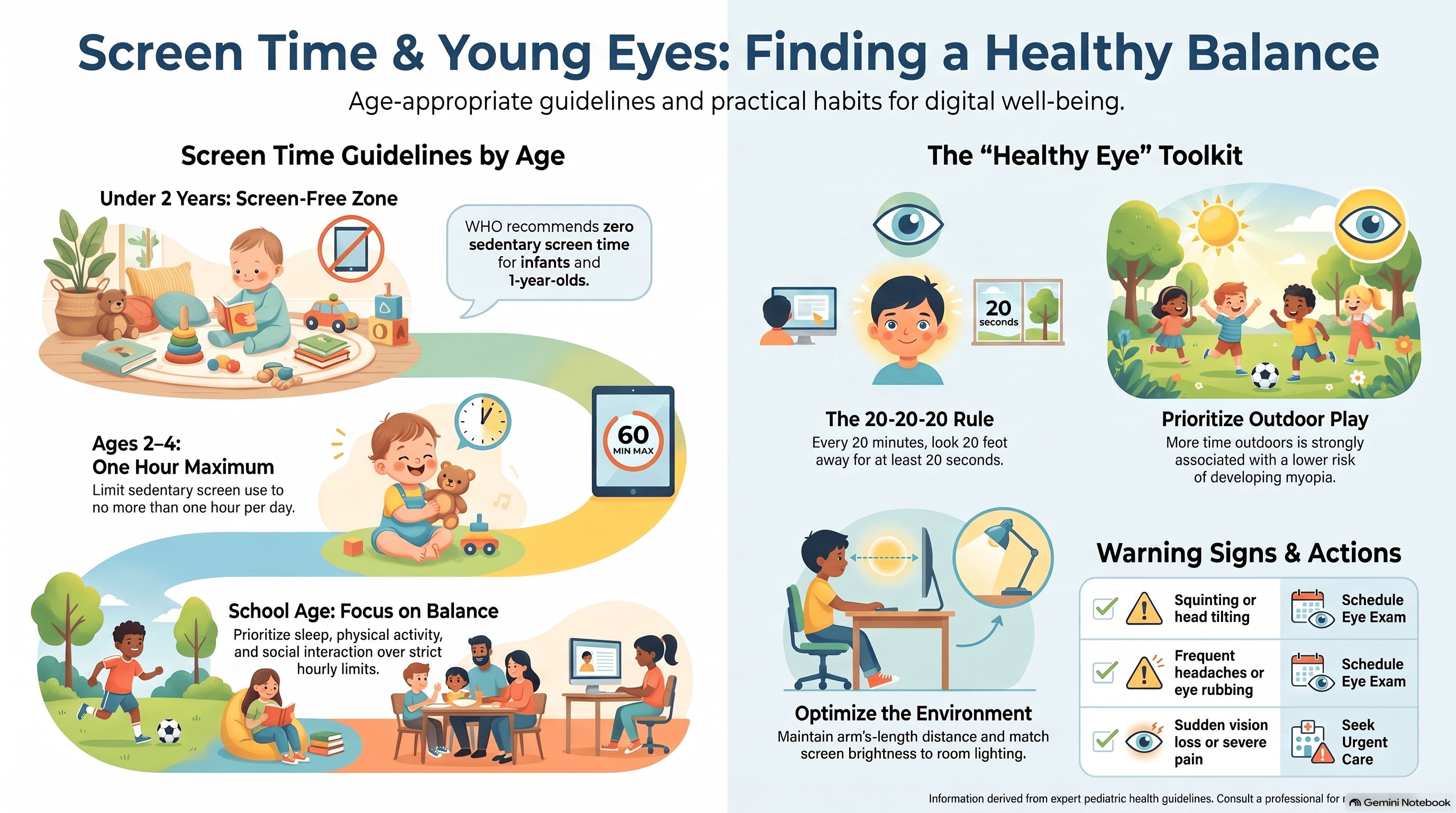
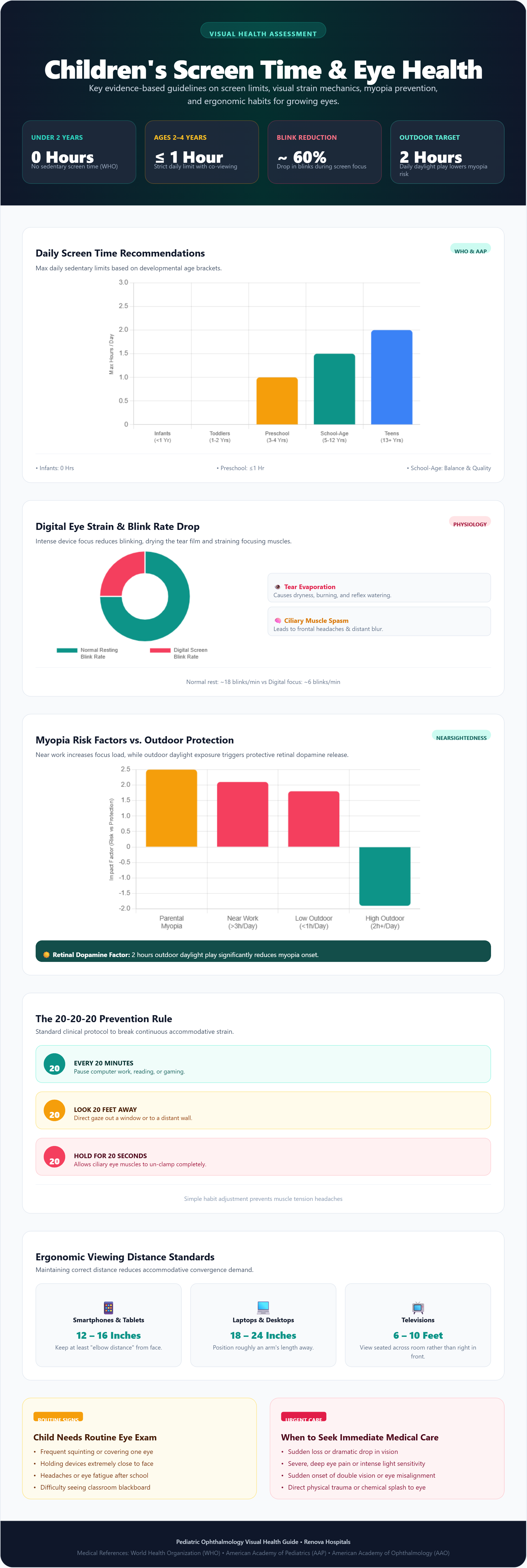
According to the World Health Organization, for children under five:
Infants Under 1 Year
Sedentary screen time is not recommended.
Interactive activities such as floor play, reading, singing, and caregiver interaction are preferred.
Children Around 1 Year
Sedentary screen time is not recommended.
Children Around 2 Years
Sedentary screen time should generally be no more than one hour per day, and less is better.
Children Aged 3–4 Years
Sedentary screen time should also generally be no more than one hour per day, with less being preferable.
WHO emphasises replacing prolonged sedentary screen time with active play, adequate sleep, and interactive non-screen activities.
How Much Screen Time Is Too Much for School-Aged Children?
For older children, the answer is less about a fixed number and more about what screen use is replacing.
The American Academy of Pediatrics does not currently recommend one universal daily screen-time limit for every child and teenager.
Instead, parents should consider whether screen use is interfering with:
- Sleep
- Physical activity
- Schoolwork
- Family time
- Outdoor play
- Face-to-face social interaction
- Healthy eating
- Emotional wellbeing
A personalised Family Media Plan can help families decide reasonable limits based on the child's age and needs.
What Is the 20-20-20 Rule?
The 20-20-20 rule is a simple way to reduce prolonged near focusing.
Encourage your child to:
- Every 20 minutes
- Look at something approximately 20 feet away
- For at least 20 seconds
These short breaks allow the focusing system to relax.
The American Academy of Pediatrics also recommends encouraging children to step away from screens regularly and spend time being physically active.
How Far Should a Child Sit From a Screen?
Viewing distance depends on the device.
As a general rule:
- Phones and tablets should not be held extremely close to the face.
- Laptop and computer screens should be positioned at a comfortable arm's-length distance where possible.
- Television should be viewed from several feet away rather than sitting directly in front of the screen.
Children who repeatedly move screens closer to their face or sit unusually close to the television may have an uncorrected vision problem and should be evaluated.
Does Screen Brightness Matter?
Yes.
Very bright screens in dark rooms or screens that are difficult to see because of glare may increase discomfort.
Parents can help by:
- Matching screen brightness to the room
- Avoiding strong reflections
- Ensuring adequate room lighting
- Increasing text size instead of bringing the device closer
- Keeping screens clean
Automatic brightness settings may also help maintain comfortable viewing conditions.
Are Blue-Light Glasses Necessary for Children?
For most children, special blue-light filtering glasses are not routinely necessary.
There is currently no strong evidence that blue light from everyday screens damages the eyes.
A better approach is to focus on:
- Regular breaks
- Correct viewing distance
- Appropriate brightness
- Outdoor activity
- Proper sleep
- Treating any underlying refractive error
Children who already wear prescription glasses should continue using the correction advised by their
ophthalmologist or optometrist.
Can Screens Make Children's Eyes Dry?
Yes.
Children often become deeply focused on games or videos and blink less frequently.
Reduced blinking allows tears to evaporate faster and may cause:
- Burning
- Grittiness
- Redness
- Watering
- Tired eyes
Encouraging breaks and conscious blinking can help.
Persistent dryness or irritation should be evaluated rather than treated repeatedly with over-the-counter eye drops.
Can Screen Time Cause Headaches?
Yes, prolonged screen use can contribute to
headaches.
Possible reasons include:
- Eye strain
- Uncorrected glasses power
- Poor posture
- Glare
- Prolonged near focusing
- Inadequate sleep
- Dehydration
Recurring headaches during reading or screen use may indicate an underlying refractive or focusing problem.
Why Is Outdoor Time Important for Children's Eyes?
Outdoor activity provides an opportunity for children to focus at different distances rather than continuously performing near work.
It also exposes the eyes to natural daylight.
Regular outdoor play is associated with a lower risk of developing
myopia and provides additional benefits for:
- Physical fitness
- Sleep
- Mood
- Weight management
- Social interaction
WHO recommends limiting sedentary behaviour and supporting adequate physical activity throughout childhood.
How Can Parents Reduce Screen-Related Eye Strain?
Encourage Regular Breaks
Use the 20-20-20 rule during prolonged homework, gaming, or online learning.
Encourage Outdoor Play
Aim for regular outdoor activity every day whenever practical.
Maintain Proper Viewing Distance
Avoid allowing children to hold phones extremely close to their eyes.
Adjust Screen Brightness
Keep brightness comfortable relative to the surrounding environment.
Increase Text Size
Children should not need to lean forward or squint to read.
Avoid Screens Before Bedtime
Screen use close to bedtime may interfere with healthy sleep routines.
The American Academy of Pediatrics recommends keeping screens away from sleeping areas and establishing device-free periods before bedtime.
Encourage Blinking
Remind children to blink normally, particularly during gaming or intensive computer use.
What Signs May Indicate a Vision Problem?
Parents should watch for:
- Squinting
- Sitting unusually close to the television
- Holding books or screens very close
- Frequent headaches
- Eye rubbing
- Covering one eye
- Head tilting while looking
- Difficulty seeing the classroom board
- Declining school performance related to vision
- Frequent blinking
- Complaints of blurred or double vision
These signs may indicate myopia, hyperopia, astigmatism, eye alignment problems, or another visual condition.
What Should Parents Avoid?
- Allowing uninterrupted screen sessions for several hours
- Letting very young children use screens for long periods
- Using screens as the only form of entertainment
- Allowing screens to replace outdoor play
- Allowing devices in bed late at night
- Keeping screens extremely close to the child's face
- Buying blue-light glasses without checking whether the child actually needs prescription glasses
- Ignoring repeated headaches or blurred vision
- Assuming every vision problem is caused by screens
Medical Review
Screen use is now unavoidable for many children because education and communication increasingly rely on digital devices.
The goal is not to eliminate technology completely but to establish healthy visual habits.
A balanced routine should include:
- Screen breaks
- Outdoor activity
- Adequate sleep
- Proper viewing distance
- Healthy posture
- Regular vision screening when appropriate
Consult an Ophthalmology Team at Renova Hospitals
Children who experience persistent eye strain, blurred vision, headaches, squinting, difficulty seeing distant objects, or frequent eye rubbing may benefit from a comprehensive eye examination.
At Renova Hospitals, our Ophthalmology specialists can evaluate refractive errors, childhood vision problems, eye alignment, digital eye strain, and other conditions affecting visual development.
Request a consultation or call 040 2333 3333.
Need Medical Guidance?
Consult Renova
Ophthalmology if your child frequently complains of blurred vision, headaches during reading, eye strain, or difficulty seeing objects at a distance.
Regular eye assessments can help identify refractive errors and other vision problems before they begin interfering with learning or daily activities.
When Does an Eye Problem Need Urgent Care?
Seek urgent medical attention if your child develops:
- Sudden loss of vision
- Severe eye pain
- Eye injury
- Chemical exposure to the eye
- Sudden double vision
- A new abnormal eye deviation
- Significant redness with severe pain or light sensitivity
- Sudden flashing lights or a curtain-like loss of vision
- Severe headache with vomiting and visual changes
These symptoms require prompt professional assessment.
Healthy Screen Habits Protect More Than the Eyes
Managing screen use is not only about preventing eye strain.
Balanced screen habits also help protect:
- Sleep
- Physical activity
- Learning
- Posture
- Emotional wellbeing
- Family interaction
Parents should focus on helping children develop sustainable digital habits rather than treating screens as either completely harmless or completely harmful.
Medical References
Medically Reviewed & Approved By
Dr. Satyanarayana Kada
Ophthalmology, Retina & Vitreoretinal Surgery
MBBS, MD (Ophthalmology), Fellowship in Medical and Surgical Management of Diseases of the Retina and Vitreous
This article has been reviewed and approved by a qualified medical professional to ensure accuracy, credibility, and adherence to current clinical standards.