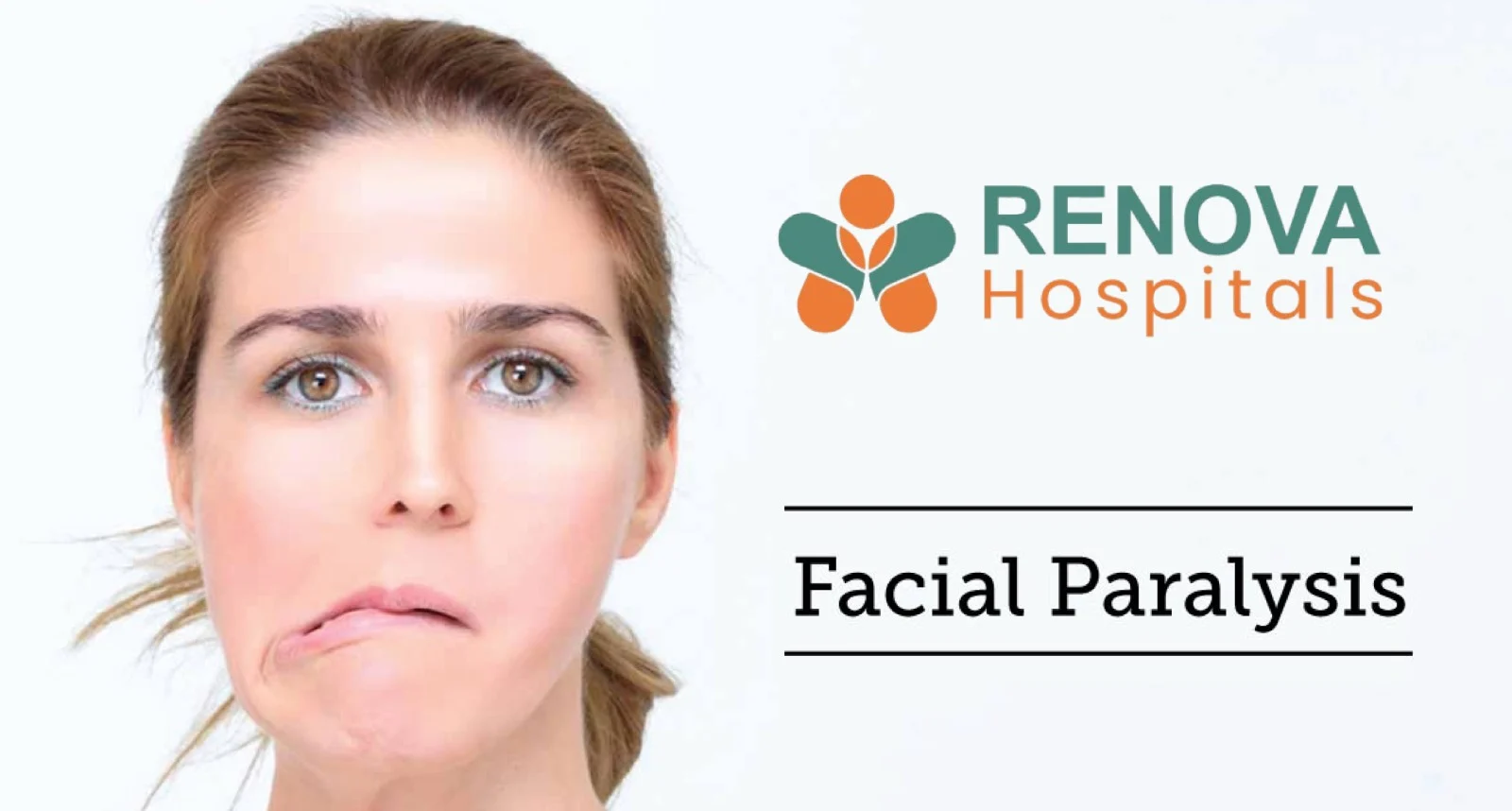
Facial paralysis — a sudden weakness or drooping on one side of the face — affects far more than appearance: it can impact your speech, eating, and even your ability to close an eye safely. Causes range from Bell's palsy to stroke, infection, or nerve injury. Because some causes are emergencies, here's how to tell them apart, and how facial paralysis is treated.
At Renova Hospitals Hyderabad, we see patients with viral nerve inflammation, traumatic injuries, stroke facial paralysis, congenital facial paralysis, transient facial nerve paralysis, tumour-related paralysis, and paralysis following ear, parotid, or brain surgery.
Each category has its own mechanism, risk factors, complications, and treatment pathways. That is why accurate diagnosis and early intervention are essential to maximising recovery.
Facial paralysis is not a single disease. It is an endpoint, a final common pathway caused by multiple medical conditions, some mild and reversible, others severe and life-altering. Understanding these variations helps patients and families navigate treatment confidently.
Understanding the Facial Nerve: Why It Is So Vulnerable
The facial nerve (cranial nerve VII) is one of the most complex nerves in the human body. It carries motor fibres to facial muscles, sensory fibres for taste, and parasympathetic fibres for tear and saliva production.
It begins deep in the brainstem, travels through narrow, curved bony tunnels in the skull, passes through the middle ear, enters the parotid gland, divides into five major branches, and spreads across the entire face.
Why is this nerve at high risk for damage?
- It passes through extremely narrow bone canals that cannot expand
- Even slight swelling compresses and chokes the nerve
- It is close to the middle ear, making infections risky
- It runs through the parotid gland, which is often involved in tumours or surgery
- It branches across the face, making trauma vulnerable
- It carries multiple functions; damage affects more than muscle movement
Because of this complexity, facial paralysis treatment must be personalised, precise, and multidisciplinary, involving neurology, ENT, radiology, physiotherapy, and sometimes reconstructive surgery.
What Causes Facial Paralysis?
Before listing causes, it is important to understand that the cause determines the urgency, prognosis, and treatment. Some causes require immediate emergency care (like stroke), while others resolve naturally (like viral inflammation). Others require surgical intervention due to nerve compression or tumour involvement.
Here is a highly expanded overview of major facial paralysis causes:
1. Bell’s Palsy / Viral Inflammation
This is the most common cause globally. It usually results from viral reactivation affecting the facial nerve.
Mechanism Explained:
Viruses like herpes simplex or herpes zoster can inflame the nerve. This inflammation occurs inside a narrow bone canal, causing the nerve to swell. Since there is no room for expansion, the nerve becomes compressed, losing conductivity and resulting in sudden paralysis.
Features:
- Sudden onset
- One-sided weakness
- The eye doesn’t close
- Pain around the ear
Importance:
This condition is the classic example of transient facial nerve paralysis, meaning recovery is likely with early management.
2. Stroke Facial Paralysis
This type involves damage to facial control centres in the brain, not the nerve itself.
Mechanism Explained:
A stroke (due to blockage or bleeding in the brain) interrupts nerve signals reaching the face. Unlike Bell’s palsy, stroke-related paralysis typically affects only the lower face and is associated with speech difficulty, limb weakness, or imbalance.
Critical Distinction:
- In stroke facial paralysis, the forehead usually remains functional.
- This helps doctors identify stroke during emergency evaluation.
Why it matters:
This is a medical emergency. Immediate treatment is life-saving.
3. Facial Paralysis After Surgery
Surgery around the ear, jaw, skull base, or parotid gland may temporarily affect the facial nerve.
Mechanism Explained:
The nerve may become bruised, stretched, overheated, or compressed during surgery. In rare cases, accidental nerve injury can occur.
Common surgeries that may trigger paralysis:
- Parotid gland tumour surgery
- Ear surgery
- Mastoidectomy
- Skull base tumour removal
- Cosmetic procedures
These cases vary widely in recovery. Some are transient, while others require nerve repair.
4. Trauma, Accidents & Injuries
Facial paralysis can result from blunt trauma, penetrating injury, road accidents, or fractures involving the skull.
Mechanism Explained:
Because the facial nerve passes through narrow bony canals near the ear, any fracture can directly injure or compress the nerve. Traumatic swelling can also block nerve signals.
Examples:
- Fracture of the temporal bone
- Deep facial cuts
- Blows to the jaw or cheek
Traumatic paralysis may be partial or complete and often requires early evaluation by specialists.
5. Tumours of the Ear, Skull Base, or Parotid Gland
These tumours may grow slowly and compress the facial nerve over months or years.
Mechanism Explained:
Tumours do not always damage the nerve initially; they simply push against it. Over time, however, pressure disrupts nerve supply, leading to gradual facial weakness.
Typical clues:
- Slow progression
- Twitching before weakness
- Ear fullness or hearing loss (if acoustic neuroma)
Tumour-related paralysis rarely improves without treating the tumour itself.
6. Congenital Facial Paralysis
Congenital facial paralysis occurs in new-borns due to developmental abnormalities of the nerve, birth trauma, or genetic syndromes.
Mechanism Explained:
The nerve may be underdeveloped, absent, or injured during delivery. Babies show asymmetrical facial movements, difficulty closing eyes, and feeding issues.
Importance:
Early therapy improves feeding, bonding, and long-term facial development.
7. Autoimmune & Neurological Conditions
Certain disorders attack the nerves or their protective coverings.
Examples:
- Guillain-Barré syndrome
- Multiple sclerosis
These can cause bilateral facial paralysis.
8. Transient Facial Nerve Paralysis
Temporary paralysis may occur due to:
- Local anaesthetic infiltration
- Minor inflammation
- Viral triggers
- Cold exposure
This is short-lived and usually reversible.
Facial Paralysis Symptoms
Symptoms depend on whether the nerve is partially or completely damaged and whether the cause is central (brain) or peripheral (nerve).
Before listing symptoms, note that even mild facial paralysis can affect emotional expression and communication.
Common Facial Paralysis Symptoms Include:
- One-sided drooping of the face
- Difficulty closing the eye or blinking
- Reduced ability to smile or show expression
- Loss of forehead movement
- Drooling while drinking
- Trouble chewing
- Difficulty speaking clearly
- Eye dryness or excessive tearing
- Flat nasolabial fold
- Facial numbness or altered sensation
- Reduced taste
- Increased sensitivity to sounds
- Tightness or pulling sensation in the face
Why symptoms matter:
Early detection improves outcomes. Eye symptoms, in particular, require urgent care to prevent corneal damage.
Types of Facial Paralysis
Understanding the type helps determine the correct treatment.
1. Peripheral Facial Paralysis
Occurs due to nerve damage outside the brain (Bell’s palsy, infections, trauma).
The entire side of the face is affected.
2. Central Facial Paralysis
Caused by a stroke.
Forehead muscles work normally.
3. Bilateral Paralysis
Both sides are affected, seen in autoimmune conditions.
4. Congenital Paralysis
Present at birth.
5. Transient Facial Nerve Paralysis
Short-term weakness due to mild nerve irritation.
Diagnosis of Facial Paralysis
Accurate diagnosis is essential because paralysis due to stroke, tumour, viral inflammation, or trauma all require very different treatments.
Diagnostic Evaluation Includes:
1. Neurological Examination
Assesses which part of the face is affected and whether forehead movement is preserved.
2. ENT Examination
Evaluates ear infections, parotid gland enlargement, and mastoid disease.
3. Imaging: MRI & CT
Identifies swelling, inflammation, tumours, fractures, or stroke.
4. Electromyography (EMG)
Measures electrical activity in facial muscles to determine whether the nerve is recovering.
5. Hearing Tests
Important because the facial nerve passes close to the auditory structures.
6. Blood tests
Help identify viral, autoimmune, or metabolic causes.
Facial Paralysis Treatment
Facial paralysis treatment must be tailored to each cause. A one-size-fits-all approach does not work.
Below is the most expanded explanation of treatment modalities.
1. Medical Treatment
Used in inflammation-related and viral causes. Reduces nerve swelling and improves recovery.
2. Eye Protection
When eyelids cannot close, the cornea is at risk of dryness, injury, and ulceration.
Eye protection includes:
- Lubricating eye drops
- Protective glasses
- Nighttime eye taping
- Moisture chambers
Without eye care, irreversible vision loss may occur.
3. Physiotherapy & Neuromuscular Retraining
Physiotherapy is essential for restoring facial movement and preventing long-term complications like muscle stiffness or synkinesis (abnormal movement).
Therapy includes:
- Guided facial exercises
- Massage and soft tissue mobilisation
- Neuromuscular retraining
- Mirror feedback therapy
- EMG-guided therapy
- Stimulation in selected cases
Highly customised programs improve symmetry and function.
4. Speech & Swallow Therapy
Used when paralysis affects speech clarity, lip control, or swallowing.
Therapy helps with:
- Safe eating
- Preventing choking
- Improving pronunciation
- Lip strength exercises
5. Surgical Treatments
If natural recovery does not occur or nerve injury is severe, surgery may help restore function.
Options include:
- Facial nerve repair
- Nerve grafts
- Cross-face nerve grafting
- Muscle transfer surgery
- Static procedures like slings for symmetry
- Eyelid procedures for blinking
These procedures aim to restore facial expression, eye protection, and symmetry.
6. Treatment for Stroke Facial Paralysis
Management includes:
- Stroke treatment and rehabilitation
- Physiotherapy
- Speech therapy
- Eye care
- Balance and gait training
Unlike nerve injury, recovery depends on the brain healing itself.
7. Treatment for Congenital Facial Paralysis
Focuses on:
- Early physiotherapy
- Feeding support
- Eye protection
- Reconstructive surgery later if needed
8. Treatment for Facial Paralysis After Surgery
Recovery depends on whether the nerve was bruised, stretched, or cut.
Requires a combination of:
- Physiotherapy
- Eye care
- Medical support
- Sometimes surgical repair
Can Facial Paralysis Be Cured?
Patients often ask: Can facial paralysis be cured?
High Recovery Chance:
- Bell’s palsy
- Inflammatory causes
- Transient facial nerve paralysis
Moderate Recovery Chance:
- Traumatic injuries
- Facial paralysis after surgery
Lower Recovery Chance:
- Long-standing paralysis
- Congenital cases
- Severe nerve transection
- Tumor-related paralysis
Recovery Depends On:
- Early diagnosis
- Cause and severity
- Patient age
- Time before treatment
- Physiotherapy consistency
- Whether the nerve is intact
Even when full recovery is not possible, rehabilitation can significantly improve function and appearance.
When to See a Facial Paralysis Doctor
Seek immediate care from a facial paralysis doctor if:
- Facial weakness develops suddenly
- Facial drooping is accompanied by speech difficulty (possible stroke)
- You cannot close your eyes
- Weakness worsens over time
- You experience facial paralysis after surgery
- Paralysis lasts more than a few days
- You notice frequent tearing, dryness, or irritation in the eye
Early intervention dramatically improves recovery outcomes.
Facial Paralysis Treatment in Hyderabad – Why Renova Hospitals?
Renova Hospitals provides advanced, multidisciplinary care for all forms of facial paralysis, including emergency stroke management, nerve rehabilitation, reconstructive surgery, and specialised physiotherapy. Patients across Telangana choose Renova for trusted, comprehensive facial paralysis treatment in Hyderabad.
FAQs
1. What causes facial paralysis?
Facial paralysis can result from viral inflammation, stroke, trauma, tumours, congenital abnormalities, or facial paralysis after surgery. A specialist evaluation is needed to identify the exact cause.
2. Can facial paralysis be cured?
In many cases, especially viral or transient facial nerve paralysis, full recovery is possible with early treatment. Recovery from trauma, tumours, or congenital paralysis varies based on severity.
3. How do I know if my facial paralysis is from a stroke?
Stroke facial paralysis usually affects only the lower face and may be accompanied by slurred speech, weakness, or imbalance. This requires emergency medical care.
4. How long does recovery take?
Recovery depends on the cause, nerve injury severity, and how quickly treatment begins. Viral cases improve within weeks to months, while traumatic or congenital cases may take longer.
5. When should I see a facial paralysis doctor?
Seek immediate help if facial drooping appears suddenly, worsens rapidly, affects eye closure, or occurs after injury or surgery. Early assessment improves recovery outcomes.