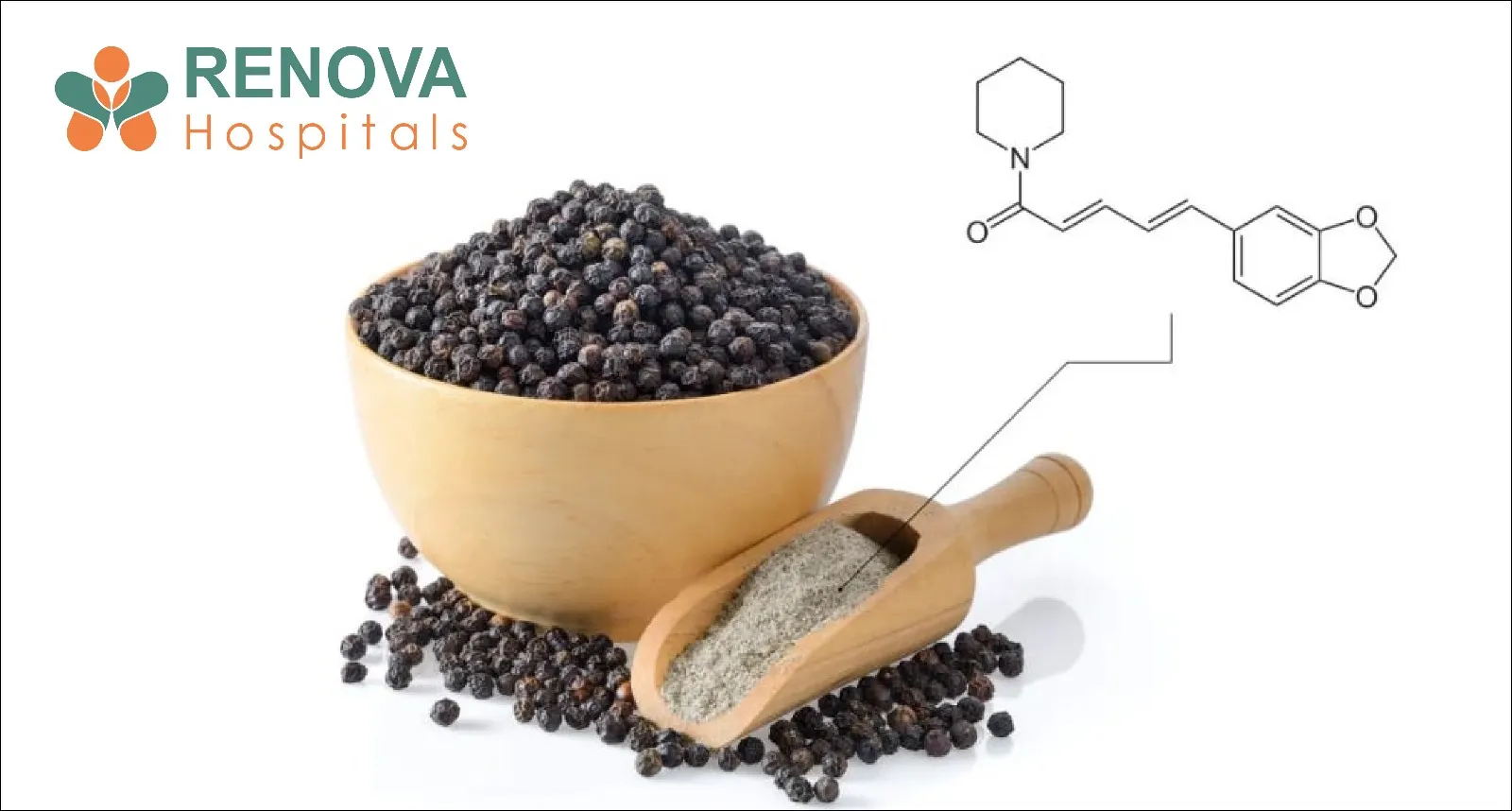
Black pepper is a staple in almost every kitchen worldwide, but there is more to this everyday spice than just flavour. The compound responsible for its sharp and pungent taste is called piperine.
Several laboratory studies indicate that piperine may help slow down the growth of certain cancer cells and trigger biological processes that lead to cancer cell death.
Researchers have explored the effects of piperine in different types of cancers, including:
- Breast cancer
- Prostate cancer
- Colon and colorectal cancer
- Lung cancer
While these early signs are promising, it is important to remember that this research is mostly limited to lab settings and animal models. Large-scale human clinical trials remain limited.
Our oncology specialists at Renova Hospitals emphasise that proven, evidence-based treatments must always remain the primary approach to
cancer care. However, research into natural compounds such as piperine may help develop supportive or complementary therapies in the future.
Key Takeaways
- Piperine is the natural compound that gives black pepper its strong taste.
- Laboratory studies suggest piperine may slow cancer cell growth.
- It may help trigger apoptosis (programmed cell death) in cancer cells.
- Research has explored its potential role in breast, prostate, colon, and lung cancers.
- Piperine may help improve the absorption of certain medicines, including chemotherapy drugs.
- Most evidence currently comes from cell studies and animal experiments.
- More human clinical research is needed to confirm safety and effectiveness.
What Is Piperine?
Piperine is a natural plant compound (alkaloid) found mainly in:
- Black pepper (Piper nigrum)
- Long pepper (Piper longum)
This compound is responsible for the distinct pungent flavour of pepper.
Piperine has been used in traditional medicine for centuries, particularly in systems such as:
- Ayurveda
- Traditional Chinese medicine
Historically, pepper-based formulations were used to support:
- Digestive health
- Respiratory conditions
- Immune function
Modern research now shows that piperine may have several biological effects, including:
- Antioxidant activity
- Anti-inflammatory effects
- Immune system support
- Antimicrobial properties
- Potential anticancer activity
Interestingly, piperine acts like a booster, helping the body absorb certain nutrients and medications more effectively, a property known as
bioavailability enhancement. Because of this, researchers are exploring whether piperine could help improve the effectiveness of certain medications, including chemotherapy drugs.
How Piperine May Affect Cancer Cells
Scientists have identified several ways in which piperine may interfere with cancer cell growth and survival. While we are still in the early stages of research, these experiments give us a fascinating look into how natural compounds interact with our biology.
1. Slowing Down Cancer Cell Growth
Cancer cells grow out of control because their internal "brakes" stop working. Research suggests that piperine may slow this process by interrupting the cell cycle, the sequence of steps cells go through to divide and multiply.
Studies have shown that piperine can cause cell cycle arrest, particularly at stages known as:
When the cell cycle stops at these stages, cancer cells cannot continue dividing. This may help reduce tumour growth.
2. Triggering Programmed Cell Death (Apoptosis)
The human body has a built-in self-destruct mechanism called apoptosis, which safely clears damaged cells. Cancer cells often avoid this process, allowing them to survive longer than they should.
Research indicates that piperine may help activate proteins that trigger apoptosis, including:
3. Interfering With Cancer Signalling Pathways
Cancer cells rely on specific molecular pathways to survive, grow, and spread.
Studies suggest that piperine may affect several important signalling pathways, including:
- PI3K/Akt pathway
- NF-κB pathway
- STAT-3 signalling
- ERK1/2 signalling
These pathways are often overactive in many cancers and contribute to:
- Tumour growth
- Metastasis (spread of cancer)
- Resistance to treatment
By suppressing these pathways, piperine may reduce cancer cell survival.
4. Creating Oxidative Stress in Cancer Cells
Cancer cells are highly sensitive to changes in oxidative balance. Some studies suggest that piperine can increase oxidative stress inside cancer cells, damaging their DNA and proteins. This stress may activate pathways that eventually lead to cell death.
Piperine and Breast Cancer Research
Breast cancer is one of the most common cancers among women worldwide. Researchers have studied the effects of piperine on several types of breast cancer cells, including triple-negative breast cancer (TNBC), which is known to be aggressive and difficult to treat.
Studies suggest that piperine may:
- Reduce breast cancer cell growth
- Decrease tumour cell movement.
- Inhibit survival pathways such as Akt signalling.
- Trigger apoptosis in cancer cells
Research involving HER2-positive breast cancer cells also showed that piperine may:
- Reduce HER2 gene expression
- Activate apoptosis-related proteins
- Increase sensitivity to certain chemotherapy drugs.
Piperine and Prostate Cancer
Prostate cancer is one of the most common cancers affecting men.
Scientists have studied the effects of piperine on both:
- Androgen-dependent prostate cancer cells
- Androgen-independent prostate cancer cells
Laboratory studies suggest that piperine may:
- Reduce prostate cancer cell growth
- Trigger apoptosis through caspase activation.
- Lower prostate-specific antigen (PSA) levels
- Reduce androgen receptor activity.
- Suppress NF-κB and STAT-3 signalling pathways.
Animal studies have also shown that
piperine treatment may reduce tumour growth in mice implanted with prostate cancer cells.
Piperine and Colon or Colorectal Cancer
Colorectal cancer is one of the most common cancers globally and is increasingly being diagnosed in India.
Studies involving colon cancer cell lines such as
HT-29 and DLD-1 suggest that piperine may:
- Prevent colony formation in cancer cells
- Stop the cell cycle
- Trigger apoptosis through cellular stress.
- Increase oxidative damage inside tumour cells.
Researchers are also exploring nano-formulations of piperine to improve its absorption and delivery to cancer cells. These advanced delivery systems could enhance the effectiveness of future therapies.
Piperine and Lung Cancer
Lung cancer remains one of the leading causes of cancer-related deaths worldwide. Studies involving
A549 lung cancer cells show that piperine may activate a tumour-suppressing protein called p53.
The p53 protein plays a critical role in preventing abnormal cell growth.
Research suggests that piperine may:
- Increase p53 activity
- Activate apoptosis-related enzymes
- Increase the Bax/Bcl-2 ratio.
- Trigger cancer cell death.
Some animal studies also suggest that piperine may reduce lung tumour formation caused by carcinogenic substances.
Piperine and Tumour Blood Supply (Angiogenesis)
Just like any other living tissue, tumours need a dedicated blood supply to thrive through a process known as angiogenesis. Research suggests that piperine may help slow tumour growth by inhibiting angiogenesis.
Experimental models show that piperine may reduce endothelial cell growth, which is responsible for forming new blood vessels. By limiting the tumour’s blood supply, piperine may slow cancer progression.
Bioavailability and Combination With Cancer Treatments
One of the most interesting properties of piperine is its ability to
enhance the absorption of drugs and nutrients. Piperine can block certain enzymes that normally break down medicines in the body. This allows drugs to remain active longer and increases their effectiveness.
Because of this property, scientists believe piperine may help:
- Improve chemotherapy drug absorption
- Enhance the effectiveness of natural anticancer compounds.
- Support combination therapies in cancer treatment
This is why piperine is being studied as a supportive compound in oncology research.
Limitations of Current Research
Although the findings from laboratory studies are promising, there are still important limitations.
Most studies on piperine and cancer have been conducted in:
- Cell culture experiments (in vitro)
- Animal studies (in vivo)
Large human clinical trials are still needed to determine:
- Safe dosage levels
- Long-term safety in cancer patients
- Drug interactions with chemotherapy
- Real clinical effectiveness in humans
The Future of Piperine in Cancer Research
Interest in plant-derived compounds is growing rapidly in cancer research.
Scientists are currently exploring several areas related to piperine, including:
- Piperine-based nano-drug delivery systems
- Combination therapies with chemotherapy drugs
- Natural compounds targeting cancer stem cells
- Clinical trials to evaluate safety and effectiveness
If future research confirms its benefits, piperine could become part of integrative oncology approaches that combine conventional treatment with supportive natural compounds.
Medical Disclaimer
This article is for informational and educational purposes only and should not be considered medical advice. Always consult a qualified healthcare professional for diagnosis, treatment, or medical guidance related to cancer or any other health condition.