HomeBlogsReverse Shoulder Replacement Surgery Explained: Benefits, Risks & Recovery Timeline
By Dr. Anoop Reddy
April 10, 2026
Reverse Shoulder Replacement Surgery Explained: Benefits, Risks & Recovery Timeline
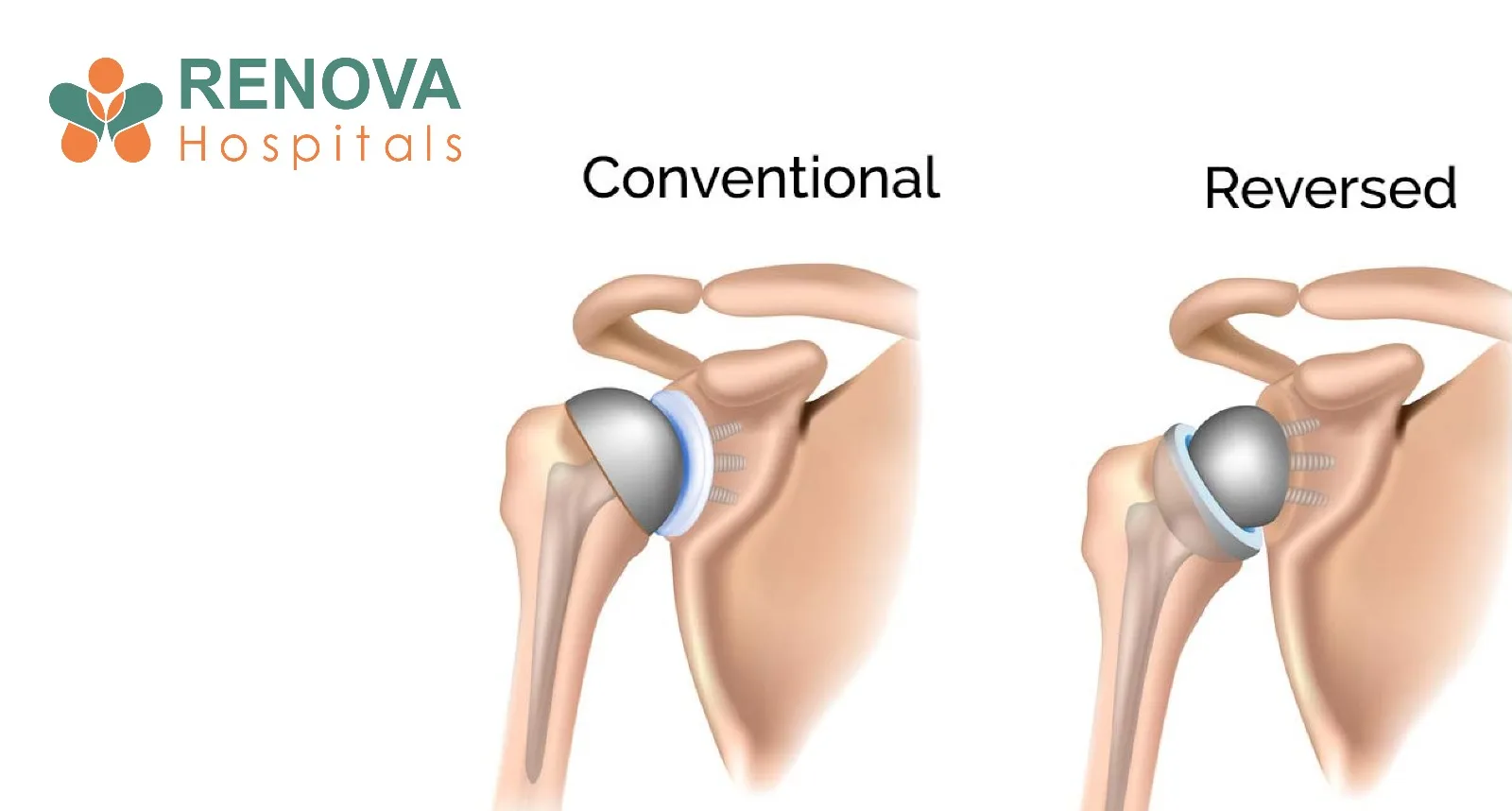
Reverse shoulder replacement is an advanced surgical procedure in which the natural shoulder joint is reversed, placing the ball on the shoulder blade and the socket on the arm bone, allowing the deltoid muscle to lift the arm when the rotator cuff is severely damaged.
It is recommended for complex shoulder fractures, irreparable rotator cuff tears, and failed prior shoulder surgeries, and consistently achieves patient satisfaction rates of around 90%. For people who have exhausted conservative options, it is often the most reliable path back to a functional, pain-free shoulder.
Key Takeaways
Reverse shoulder replacement works by reversing the ball-and-socket joint, allowing the deltoid muscle to move the arm independently of the rotator cuff, making it effective even in cases of severe tendon damage or bone loss.
Patient satisfaction exceeds 90%, and implant survival reaches 88-93% at 10 years, making it one of the most reliable procedures in joint replacement surgery.
It is the preferred treatment for complex proximal humerus fractures, massive irreparable rotator cuff tears, rotator cuff tear arthropathy, and failed prior shoulder surgeries.
Recovery takes 6-12 months, with the greatest gains in pain relief and mobility occurring in the first 3 months; a structured physiotherapy programme is essential to the outcome.
When previous shoulder replacements fail with severe bone loss, a third revision using a custom implant, as recently performed by Dr. Anoop Reddy Sama at Renova Hospitals, Hyderabad, represents the frontier of what modern shoulder surgery can achieve.
What Is Reverse Shoulder Replacement Surgery?
Reverse shoulder replacement (Reverse Total Shoulder Arthroplasty) is a specialised orthopaedic procedure designed for patients who cannot benefit from traditional shoulder surgery. Instead of repairing damaged tendons, this surgery alters the shoulder's biomechanics, enabling movement through the deltoid muscle.
Who Needs a Reverse Shoulder Replacement?
Reverse shoulder arthroplasty is recommended when the shoulder joint is too severely damaged for conventional repair. Common indications include:
Severe rotator cuff tear that cannot be repaired
Chronic shoulder pain with inability to lift the arm
Complex shoulder fractures (especially in older adults)
Failed previous shoulder replacement surgery
Rotator cuff arthropathy (arthritis due to tendon damage)
Reverse shoulder replacement surgery involves removing damaged parts of the shoulder joint and replacing them with artificial implants to restore movement and reduce pain.
During reverse shoulder replacement surgery, the surgeon will:
Remove the damaged humeral head (ball of the joint)
Attach a metal ball (glenosphere) to the shoulder blade
Insert a metal stem with a plastic socket into the upper arm bone
Reconstruct and stabilise the surrounding bone using sutures or grafts, if required
Modern techniques such as advanced imaging, custom implant planning, and computer-assisted surgery have improved precision and outcomes. In select cases, minimally invasive approaches help reduce tissue damage and support faster recovery.
How Long Does Recovery Take After Reverse Shoulder Replacement?
Recovery after reverse shoulder replacement is gradual and guided through a structured rehabilitation plan. Most patients experience significant pain relief and improved movement within the first few months.
Typical recovery timeline:
Weeks 1โ4: Arm is supported in a sling; pain is controlled, and gentle movements begin
Weeks 4โ8: Physiotherapy focuses on improving the range of motion and shoulder mobility
Months 3โ6: Strengthening exercises are introduced as healing progresses
6โ12 months: Return to daily activities, with some patients resuming light sports
Most functional improvement occurs in the first 3 months, while full recovery may take up to a year, depending on individual healing and rehabilitation.
Reverse shoulder replacement is generally a safe and effective procedure, but like any surgery, it carries some risks. Understanding these helps patients make informed decisions and recognise early warning signs.
Possible risks include:
Infection (1โ3%) โ Usually rare and manageable with timely treatment
Shoulder dislocation โ Uncommon, especially with proper surgical technique and rehabilitation
Scapular notching โ Contact between the implant and the shoulder blade, monitored over time
Periprosthetic fracture โ Fracture of the bone around the implant
Implant loosening โ Can occur over many years due to wear or stress
Overall, complication rates are low, and outcomes are highly favourable when the procedure is performed by experienced specialists and followed by proper rehabilitation.
What Happens When a Reverse Shoulder Replacement Fails? Can It Be Redone?
Yes, reverse shoulder replacement can be revised, but it is significantly more complex and requires highly specialised surgical expertise.
When a reverse shoulder replacement fails due to implant loosening, infection, dislocation, or severe bone loss, a procedure called revision reverse shoulder arthroplasty (RRSA) is performed.
Why is revision surgery more complex?
Existing implants must be carefully removed or adjusted
Bone quality may be severely compromised
Shoulder anatomy is often altered by previous surgeries
Reconstruction requires precise planning and execution
In a recent landmark case at Renova Hospitals, Hyderabad, Dr. Anoop Reddy Sama performed a third revision reverse shoulder arthroplasty using a custom implant, a procedure undertaken when two previous shoulder replacements had failed in the setting of severe bone loss. Custom implants are engineered specifically for the individual patient's anatomy when standard implant options are no longer viable due to bone deficiency.
Cases of this complexity are exceedingly rare, requiring meticulous preoperative planning, expert knowledge of shoulder biomechanics, and the technical precision to rebuild a joint significantly altered by multiple prior surgeries. Performing a third revision under these conditions is among the most demanding work in shoulder surgery.
The Bottom Line
Reverse shoulder replacement is not just a surgical option; itโs often a turning point for patients who have lost function, independence, and quality of life due to severe shoulder damage. When conventional treatments fail, this procedure offers a reliable path to pain relief, improved mobility, and restored confidence.
With modern surgical techniques, long-term implant durability, and structured rehabilitation, outcomes today are more predictable than ever. The key lies in early evaluation, correct diagnosis, and choosing an experienced specialist who can tailor the treatment to your specific condition.
If shoulder pain is limiting your daily life or sleep, donโt ignore it. The right intervention at the right time can make a life-changing difference.
Our healthcare specialists are equipped with the knowledge and skills to
provide you with the support you require. From consultation to diagnosis to treatments, our experts are
dedicated to helping you.
Dr. Anoop Reddy Sama
Orthopaedics
12 years Experience
Telugu, English, Hindi, Tamil, Malayalam, Tulu
Renova Century Hospital - Banjara Hills
MS Orthopedics, Fellowship in Shoulder Surgery(Fra...
Our healthcare specialists are equipped with the
knowledge and skills to provide you with the support you require. From consultation to diagnosis to
treatments, our experts are dedicated to helping you.
Common childhood injuries and ways to prevent them
10 April 2026
|
By
Kids are bustling with energy, zooming in and out of th...
Find quick answers to common questions about our services, doctors, and care at Renova Hospitals. So you can feel informed and confident at every step.
What is reverse shoulder replacement?
It is a surgery where the shoulder joint is reversed so the deltoid muscle can move the arm when the rotator cuff is damaged.
Who needs reverse shoulder replacement?
Patients with severe rotator cuff tears, complex fractures, or failed shoulder surgeries may need this procedure.
How successful is reverse shoulder replacement?
It has a high success rate, with around 90% of patients experiencing pain relief and improved movement.
How long does recovery take?
Recovery usually takes 6โ12 months, with major improvement seen in the first 3 months.
Is reverse shoulder replacement painful?
The surgery is done under anesthesia, and post-operative pain is well managed with medications.
How long does the implant last?
Most implants last over 10 years without needing replacement.
What are the risks of this surgery?
Risks include infection, dislocation, and implant loosening, but these are relatively uncommon.
Can this surgery be done after a failed shoulder surgery?
Yes, it can be done as a revision procedure, though it is more complex and requires expert care.
When should I see a doctor for shoulder pain?
If pain persists, movement is restricted, or daily activities are affected, you should consult a specialist.
How can I book an appointment?
You can book an appointment at Renova Hospitals by calling 040 2333 3333 or visiting the hospital for a consultation with a shoulder specialist.