Chickenpox is a highly contagious viral infection best known for its itchy, blistering rash — but in adults and during pregnancy it can be more severe. Knowing how it spreads and how to ease symptoms safely helps you recover faster and protect those around you. Here's what causes chickenpox, how to treat it, and how vaccination prevents complications.
According to the
Centers for Disease Control and Prevention (CDC), before the varicella vaccine was introduced in 1995, approximately 4 million people in the United States contracted chickenpox every year, leading to around 10,500 hospitalisations and 100-150 deaths annually. Post-vaccination, incidence has dropped by more than 90%.
At Renova Hospitals, our specialists provide expert guidance on early diagnosis, vaccination, and the management of chickenpox and its complications.
Key Takeaways:
- What causes chickenpox? The varicella-zoster virus (VZV).
- How does it spread? Through respiratory droplets or direct contact with blister fluid.
- How long is it contagious? From 1–2 days before the rash appears until all blisters have scabbed.
- How long does chickenpox last? Most people recover in 10–14 days.
- Can adults get chickenpox? Yes. Unvaccinated adults are at risk and often experience more severe symptoms.
Symptoms of Chickenpox
Chickenpox symptoms typically appear 10 to 21 days after exposure to the chickenpox virus. The illness usually begins with non-rash symptoms, followed by the characteristic blister rash.
Early Symptoms (Before the Rash)
- Mild to moderate fever
- Fatigue and general weakness
- Headache
- Loss of appetite
- Stomach discomfort or nausea
The Three Stages of the Chickenpox Rash
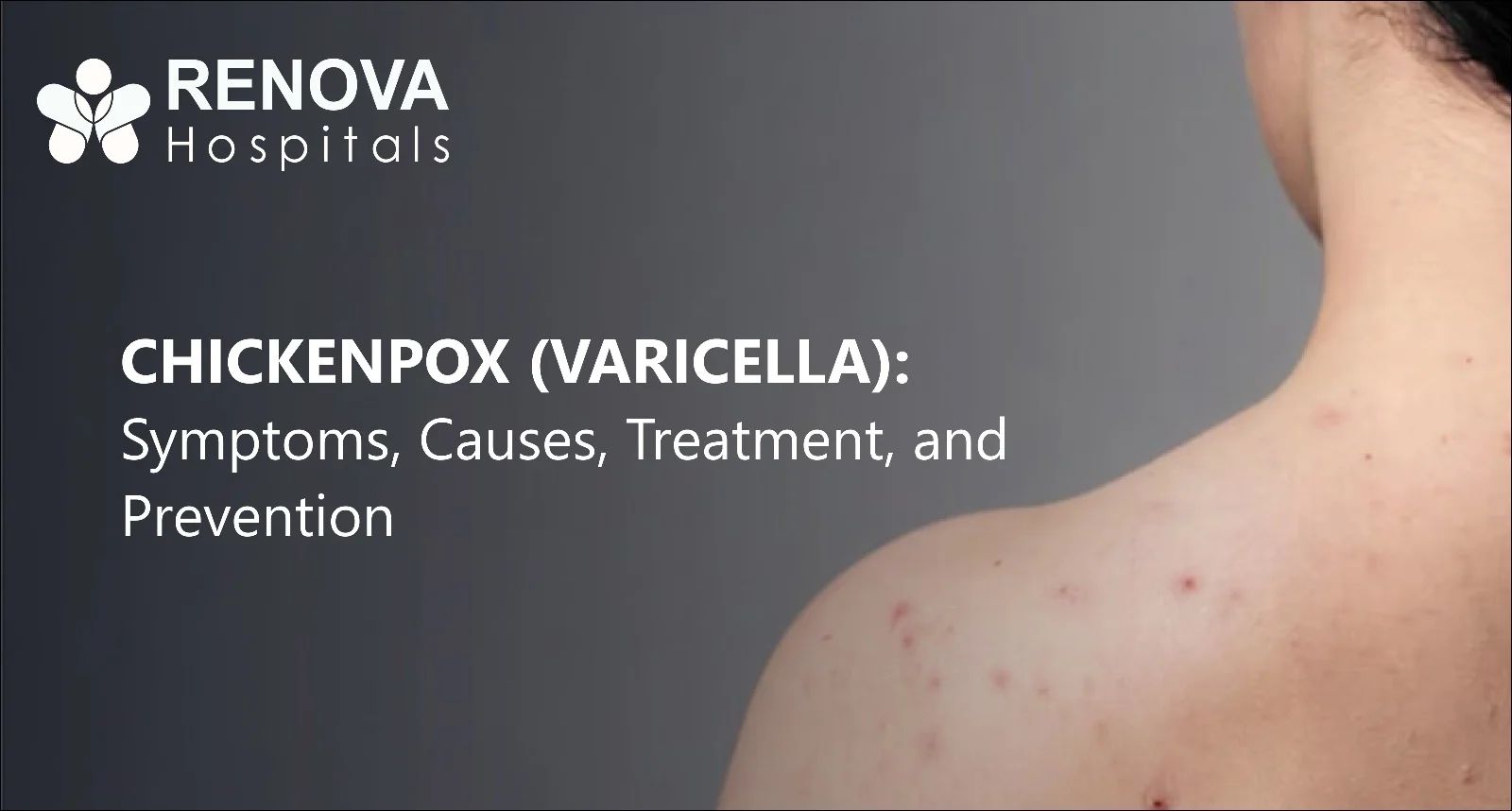
Stage 1 - Red Spots: Small red or pink bumps (papules) appear, usually on the face, chest, or back first, then spread to the arms, legs, scalp, and sometimes inside the mouth.
Stage 2 - Blisters: The bumps fill with fluid and become itchy blisters (vesicles). This is when the infection is most contagious.
Stage 3 - Scabs: Blisters break open, ooze, dry out, and form scabs that gradually heal. It is important not to scratch, as this can cause secondary skin infections and scarring.
Notably, all three stages may be present simultaneously on the body during active infection, a hallmark feature that helps distinguish chickenpox from other rash illnesses.
What Causes Chickenpox and How Does It Spread?
Chickenpox is caused by the varicella-zoster virus (VZV), a member of the herpesvirus family. It is among the most contagious viruses known — an infected person can transmit the virus to up to 90% of unvaccinated close contacts, according to
the World Health Organization.
How the Chickenpox Virus Spreads
- Airborne respiratory droplets from coughing or sneezing
- Direct contact with fluid from open blisters
- Contact with bodily fluids such as saliva or nasal secretions
- Indirect contact with recently contaminated surfaces (less common)
Difference Between Smallpox and Chickenpox
A common source of confusion is the smallpox vs chickenpox distinction. While both diseases cause a blister-like rash, they are caused by entirely different viruses and differ significantly in severity, appearance, and outcome.
Chickenpox and Smallpox Difference: Key Comparisons
Causative Virus: Chickenpox is caused by the varicella-zoster virus; smallpox was caused by the variola virus.
Rash Distribution: In chickenpox, the rash starts on the trunk and face, then spreads outward. Smallpox lesions appeared uniformly across the face and extremities, including the palms and soles, a pattern not seen in chickenpox.
Rash Stages: Chickenpox lesions appear in crops at different stages simultaneously. Smallpox lesions all developed at the same stage at the same time.
Depth of Lesions: Chickenpox blisters are superficial and relatively small. Smallpox pustules were deeper, larger, and more uniform.
Severity: Chickenpox is generally mild in healthy children. Smallpox had a mortality rate of approximately 30% among infected individuals.
Current Status: Smallpox was officially eradicated in 1980 following a global WHO vaccination campaign. Chickenpox continues to circulate but is preventable through vaccination.
Vaccination: The chickenpox vaccine uses a live attenuated form of VZV. Smallpox vaccination used the vaccinia virus and is no longer given to the general public.
Understanding the chickenpox and smallpox difference is important for accurate diagnosis, especially since chickenpox still affects unvaccinated populations globally.
Chickenpox and Pregnancy: Risks and Precautions
Chickenpox and pregnancy is a serious combination. Pregnant women who have never had chickenpox or the vaccine are at significant risk if exposed to the virus. The consequences can be severe for both the mother and the unborn baby.
Risks to the Mother
Pregnant women are more likely to develop severe chickenpox complications, including varicella pneumonia, which occurs in up to 10-20% of pregnant women with chickenpox, according to
the Royal College of Obstetricians and Gynaecologists. Other risks include hepatitis and encephalitis.
Risks to the Unborn Baby
Congenital Varicella Syndrome (CVS): If chickenpox is contracted in the first 20 weeks of pregnancy, there is a small risk (approximately 1–2%) of the baby developing CVS, which can cause limb abnormalities, eye defects, brain damage, and skin scarring.
Neonatal Chickenpox: If the mother develops chickenpox within 5 days before to 2 days after delivery, the newborn may develop a severe and potentially life-threatening form of chickenpox, as the baby will not have received protective maternal antibodies in time.
What Should Pregnant Women Do?
- Pregnant women who have not had chickenpox should avoid contact with infected individuals.
- If exposed to chickenpox, seek immediate medical advice. Varicella-zoster immune globulin (VZIG) may be recommended within 10 days of exposure.
- The chickenpox vaccine cannot be given during pregnancy; vaccination should be completed before becoming pregnant.
- After delivery, vaccination should be discussed with a healthcare provider.
Complications of Chickenpox
While most healthy children recover without problems, the chickenpox virus can lead to serious complications in high-risk groups.
- Bacterial skin infections: Secondary infection of blisters is the most common complication.
- Pneumonia: More common in adults, adolescents, and immunocompromised individuals.
- Encephalitis: Brain inflammation occurs in roughly 1 in 1,000 cases, per CDC data.
- Dehydration: Particularly in young children with mouth blisters.
- Reye's syndrome: A rare but serious condition linked to aspirin use in children with viral infections.
- Shingles (Herpes Zoster): Later reactivation of the dormant virus causes a painful rash, typically in adults over 50.
Groups at higher risk of severe illness include: pregnant women, newborns, adults over 18, immunocompromised individuals, cancer patients undergoing chemotherapy, and organ transplant recipients.
Diagnosis and Tests
Chickenpox is usually diagnosed clinically, by examining the characteristic rash and reviewing symptoms. In complicated cases or high-risk patients, additional tests may be required:
- Blood tests to assess immunity and detect the virus
- PCR testing of blister fluid for definitive viral confirmation
- Antibody (serology) testing to confirm past infection or vaccination immunity
These tests also help rule out other rash-causing conditions, such as hand, foot, and mouth disease or impetigo.
Medication for Chickenpox and Treatment Options
Chickenpox usually resolves on its own within 10 to 14 days. The primary goal of treatment is to relieve symptoms. Here is a complete overview of medication for chickenpox and supportive care options:
Home Remedies and Supportive Care
- Ensure adequate rest and stay well hydrated
- Apply cool, damp compresses to itchy areas to reduce discomfort
- Keep skin clean and cool, avoid overheating
- Trim fingernails short to minimise skin damage from scratching
- Use calamine lotion or antihistamine creams to ease itching
- Bathe in lukewarm water with added colloidal oatmeal
- Follow a soft diet if blisters develop inside the mouth
Fever and Pain Relief Medication
Paracetamol (acetaminophen) is the recommended medication for chickenpox fever and discomfort in both children and adults.
Important Warning: Aspirin (ibuprofen-based NSAIDs) must NEVER be given to children with viral infections, including chickenpox. Aspirin use in children with viral illness is associated with Reye's syndrome, a rare but life-threatening condition affecting the brain and liver.
Antiviral Medication for Chickenpox
For high-risk patients, including adults, pregnant women, immunocompromised individuals, and those with severe disease, doctors may prescribe antiviral medication for chickenpox, most commonly acyclovir. According to
NICE guidelines, acyclovir is most effective when started within 24 hours of rash onset.
Other antiviral agents such as valacyclovir or famciclovir may also be used in adults, depending on clinical assessment.
Chickenpox Treatment in Infants
If a newborn or young infant develops signs of chickenpox, seek medical attention immediately. Neonatal chickenpox can be life-threatening and may require intravenous antiviral therapy and hospitalisation.
How to Prevent Chickenpox: Vaccination and Precautions
Vaccination is the single most effective strategy for how to prevent chickenpox. The varicella vaccine is safe, well-tolerated, and more than 90% effective at preventing chickenpox disease, and up to 99% effective at preventing severe illness, according to
CDC vaccination data.
Chickenpox Vaccine Schedule for Children
- First dose: 12-15 months of age
- Second dose: 4-6 years of age
Two doses provide significantly stronger and longer-lasting protection than a single dose.
Chickenpox Vaccine for Adults
The chickenpox vaccine for adults is available and recommended for those who have never had chickenpox and have not previously been vaccinated. Adults typically receive two doses, spaced 4-8 weeks apart
The vaccine is particularly important for:
- Adults in close contact with young children (teachers, healthcare workers, daycare staff)
- Women of childbearing age who are not pregnant
- Adults living with immunocompromised individuals
- International travellers going to high-risk regions
The
NHS and CDC both recommend vaccination for non-immune adults, especially those in high-risk occupations.
Who Should Avoid the Vaccine?
- Pregnant women (vaccination should wait until after delivery)
- People with severe immune system disorders
- Individuals with known allergy to vaccine components (e.g., neomycin, gelatin)
- Those with a severe active illness at the time of vaccination
Always consult a healthcare provider for personalised vaccination advice.
Additional Preventive Measures
- Isolate infected individuals until all blisters have scabbed over
- Wash hands frequently and avoid touching eyes, nose, or mouth
- Avoid sharing clothing, bedding, or towels with an infected person
- Ventilate living spaces regularly
In healthcare settings, strict infection control measures, including negative-pressure isolation rooms, are used to prevent the spread of the chickenpox virus.
How Are Chickenpox and Shingles Related?
After recovery from chickenpox, the varicella-zoster virus remains dormant in nerve ganglia. In later life, particularly after the age of 50 or in immunocompromised individuals, the virus can reactivate as shingles (herpes zoster), causing a painful, localised rash.
According to
CDC shingles data, approximately 1 in 3 people in the United States will develop shingles during their lifetime.
People with active shingles cannot spread shingles directly. However, they can transmit the varicella-zoster virus to someone who has never had chickenpox or been vaccinated, who would then develop chickenpox rather than shingles.
A separate shingles vaccine (Shingrix) is recommended for adults aged 50 and over to reduce the risk of shingles and its complications, including post-herpetic neuralgia.
Recovery, Prognosis, and Returning to School
Most people, especially healthy children, recover from chickenpox within 10 to 14 days without complications. After recovery, the immune system produces antibodies that provide long-lasting protection against future chickenpox infection.
Can You Get Chickenpox Twice?
It is uncommon but possible to get chickenpox more than once. Second infections are more likely in people with weakened immune systems or those who had a very mild first infection.
When Can Children Return to School after Chickenpox?
Children can return to school once all blisters have fully scabbed over, typically 7 to 10 days after the rash first appears. No blister should remain open or weeping before the child re-enters a communal environment.
When to See a Doctor
Contact a healthcare provider if your child or a family member with chickenpox develops any of the following warning signs:
- Persistent high fever (above 39°C / 102°F) lasting more than 4 days
- Severe or worsening headache
- Rash spreading to, or near, the eyes
- Blisters with pus, increasing redness, or significant swelling
- Difficulty breathing or chest pain
- Extreme fatigue, confusion, or loss of coordination
- Refusal to drink fluids or signs of dehydration
Adults, especially pregnant women, individuals with weakened immunity, or those who are immunocompromised, should seek medical evaluation promptly at the first sign of chickenpox.
Expert Chickenpox Care at Renova Hospitals
Chickenpox is generally a mild illness, but it can cause serious complications in certain individuals, particularly pregnant women, newborns, immunocompromised patients, and unvaccinated adults. The introduction of the varicella vaccine has been one of the most impactful public health developments in paediatric medicine, dramatically reducing the global burden of the chickenpox virus.
At Renova Hospitals, our infectious disease specialists provide comprehensive care. from vaccination guidance and early diagnosis to management of severe cases and complications. If you suspect chickenpox in yourself, your child, or a family member, do not hesitate to consult a healthcare professional for timely and personalised evaluation.
Note: This article is for informational purposes only and does not substitute professional medical advice, diagnosis, or treatment. Always consult a qualified healthcare provider for guidance specific to your situation.